
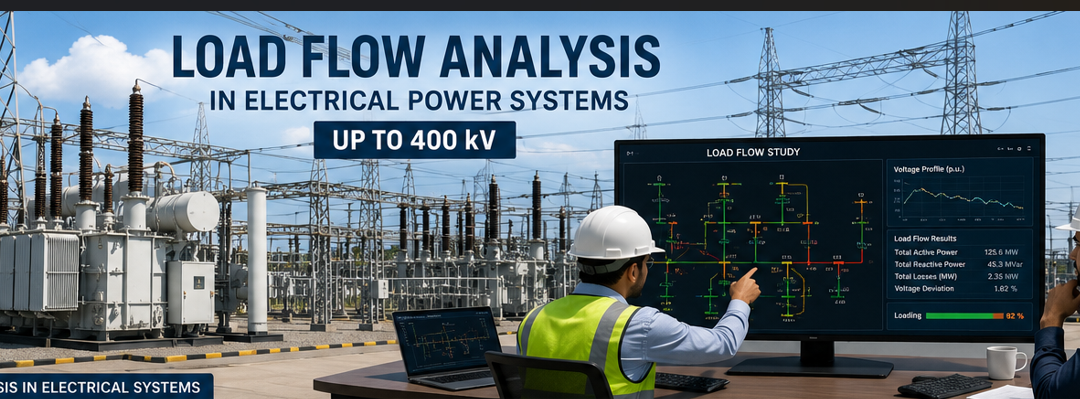
Modern electrical power systems are becoming increasingly complex due to rapid industrialization, renewable energy integration, smart grid technologies, and higher electricity demand. Therefore, engineers must evaluate how electrical power flows through an entire network before commissioning or expanding any electrical system.
Load Flow Analysis, also known as Power Flow Analysis, is one of the most important engineering studies used to determine bus voltages, active power, reactive power, transformer loading, feeder loading, and overall system performance. It helps engineers ensure that every electrical component operates safely, efficiently, and within design limits.
Whether it is an industrial plant, commercial building, renewable energy project, utility substation, or transmission network, performing a professional Load Flow Analysis minimizes operational risks, improves system reliability, reduces energy losses, and ensures compliance with international engineering standards.

Table of Contents
- What is Load Flow Analysis?
- Why Load Flow Analysis is Important
- Parameters Calculated During a Load Flow Study
- Input Data Required
- Types of Load Flow Methods
- How Engineers Perform the Study
- Software Used for Load Flow Studies
- Industrial Applications
- Benefits of Performing a Load Flow Study
- Related Power System Studies
What is Load Flow Analysis?
Load Flow Analysis is a mathematical simulation performed to determine how electrical power flows through an electrical network under steady-state operating conditions. It calculates the voltage magnitude, voltage angle, active power, reactive power, power factor, line current, transformer loading, and transmission losses throughout the system.
Unlike Electrical Load Calculation , which estimates the connected electrical demand, Load Flow Analysis determines how that electrical demand behaves throughout the complete electrical network.
Similarly, this study is usually performed together with Short Circuit Calculation , Relay Coordination Study , Voltage Drop Calculation and Power Factor Correction to verify complete electrical system performance.
Why is Load Flow Analysis Important?
Modern electrical systems contain multiple transformers, motors, capacitor banks, switchgear, distribution panels, renewable energy sources, generators, and transmission feeders.
Without this study, engineers cannot accurately determine whether the electrical system will operate safely under different loading conditions.
A professional Load Flow Study helps engineers:
- Verify voltage stability.
- Prevent transformer overloading.
- Identify overloaded feeders.
- Reduce electrical losses.
- Improve power factor performance.
- Optimize equipment selection.
- Increase overall system efficiency.
- Support future network expansion.
- Improve operational reliability.
- Reduce maintenance costs.
Furthermore, utilities, industrial facilities, commercial buildings, renewable energy plants, and EPC contractors rely on this study before commissioning new substations, expanding electrical infrastructure, or integrating additional electrical loads.
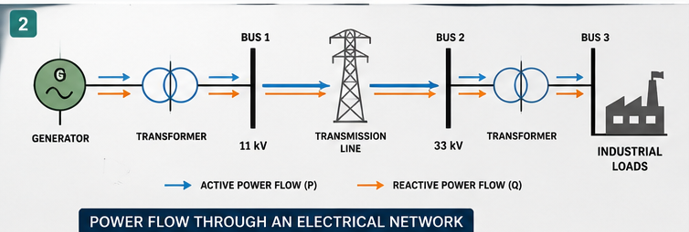
Parameters Calculated During a Load Flow Study
A comprehensive Load Flow Study calculates numerous electrical parameters that help engineers understand the behavior of the entire power system. These values are essential for designing safe, economical, and efficient electrical networks.
The study typically calculates:
- Bus voltages
- Voltage angle
- Active power (MW)
- Reactive power (MVAr)
- Apparent power (MVA)
- Transformer loading
- Feeder loading
- Power factor
- Transmission losses
- Distribution losses
- Generator output
- Slack bus performance
These results allow engineers to identify overloaded equipment, optimize power distribution, reduce electrical losses, and improve the long-term reliability of industrial facilities, substations, commercial buildings, renewable energy plants, and utility transmission networks.
Input Data Required for Load Flow Analysis
The accuracy of a Load Flow Analysis depends on the quality of the electrical system data provided. Before starting the simulation, engineers collect complete information about the power network, equipment ratings, operating conditions, and system configuration.
Accurate input data ensures reliable simulation results and helps engineers make informed decisions regarding equipment selection, network expansion, voltage regulation, and system optimization.
Typical Input Data Includes:
- Single Line Diagram (SLD)
- Transformer ratings and impedance values
- Generator ratings and operating limits
- Bus voltage levels
- Transmission line parameters
- Cable impedance and length
- Connected load details (MW & MVAr)
- Power factor of connected loads
- Capacitor bank ratings
- Reactor details
- Switchgear configuration
- Existing operating conditions
In industrial facilities, engineers also consider future expansion plans, standby generators, renewable energy integration, and emergency operating scenarios before finalizing the Load Flow Study.
Types of Load Flow Analysis Methods
Various mathematical techniques are available for solving power flow equations. The selection of the appropriate method depends on the size, complexity, and accuracy requirements of the electrical network.
1. Gauss-Seidel Method
The Gauss-Seidel Method is one of the oldest techniques used for power flow calculations. It is simple to understand and implement but requires more iterations for large power systems. Therefore, it is generally used for educational purposes or small electrical networks.
2. Newton-Raphson Method
The Newton-Raphson Method is the most widely used power flow technique because of its fast convergence, high accuracy, and excellent performance for medium and large power systems. Most commercial power system software uses this algorithm.
3. Fast Decoupled Load Flow Method
The Fast Decoupled Method reduces computational time by simplifying the mathematical equations while maintaining acceptable accuracy. It is commonly applied to large transmission networks where faster calculations are required.
Comparison of Load Flow Methods
| Method | Speed | Accuracy | Applications |
|---|---|---|---|
| Gauss-Seidel | Slow | Moderate | Small Systems |
| Newton-Raphson | Fast | Very High | Industrial & Utility Networks |
| Fast Decoupled | Very Fast | High | Large Transmission Systems |
How Engineers Perform Load Flow Analysis
Professional electrical engineers follow a systematic procedure to perform power flow simulations and verify the operating condition of the electrical network before commissioning.
Typical Engineering Process
- Collect the Single Line Diagram (SLD).
- Gather transformer, generator, cable, and load data.
- Create the electrical model using professional software.
- Assign bus types, voltage levels, and operating conditions.
- Run Load Flow simulations under normal operating conditions.
- Evaluate voltage profile and transformer loading.
- Identify overloaded feeders and excessive power losses.
- Recommend corrective actions such as capacitor banks, network reconfiguration, or equipment upgrades.
- Prepare the final engineering report with recommendations.
Professional Load Flow Studies are generally carried out using software such as ETAP, DIgSILENT PowerFactory, SKM Power Tools, EasyPower, and PSCAD. These applications provide accurate simulations for industrial plants, substations, renewable energy systems, and utility transmission networks.
Engineers usually perform this study together with Power System Studies , Substation Design , Protection Design , and Cable Design Services to ensure complete electrical system reliability and compliance with international standards.
Software Used for Load Flow Analysis
Modern power flow analysis is performed using advanced electrical engineering software that accurately simulates power flow under various operating conditions. Instead of relying on manual calculations, engineers use specialized software to analyze complex industrial power systems quickly and efficiently. Consequently, the possibility of design errors is significantly reduced.
Moreover, these software applications help engineers optimize equipment ratings, improve voltage profiles, reduce electrical losses, and verify compliance with international engineering standards before a project is commissioned.
Popular Software Used for Load Flow Studies
- ETAP (Electrical Transient Analyzer Program)
- DIgSILENT PowerFactory
- SKM Power Tools
- EasyPower
- PSCAD
- PowerWorld Simulator
- CYME Power Engineering Software
- MATLAB / Simulink
Among these applications, ETAP and DIgSILENT PowerFactory are widely used for industrial plants, utility substations, renewable energy projects, and transmission networks because they provide highly accurate simulation results.

Industrial Applications of Load Flow Analysis
Load Flow Analysis is not limited to power utilities alone. In fact, almost every medium and high-voltage electrical installation requires a professional power flow study before commissioning or expansion. Therefore, engineers perform this study during the design stage to ensure safe and reliable operation.
Applications of the Study
- Industrial Manufacturing Plants
- Electrical Substations up to 400 kV
- Oil & Gas Facilities
- Renewable Energy Projects
- Solar Power Plants
- Wind Farms
- Commercial Buildings
- Data Centers
- Hospitals
- Metro Rail Projects
- Utility Transmission Networks
- Infrastructure Projects
Furthermore, industries planning future expansion often perform Load Flow Studies to determine whether the existing electrical infrastructure can safely support additional loads. As a result, unnecessary equipment replacement costs can be avoided.
Similarly, engineers combine this study with Short Circuit Study , Relay Coordination Study , Protection Design , and Substation Design to achieve a complete electrical system assessment.
Benefits of Performing a Load Flow Study
A professional Load Flow Study provides numerous technical and financial benefits throughout the lifecycle of an electrical project. Most importantly, it allows engineers to identify potential issues before they become costly operational failures.
Key Benefits
- Improves voltage stability.
- Reduces electrical power losses.
- Optimizes transformer utilization.
- Prevents feeder overloading.
- Improves equipment life.
- Supports future network expansion.
- Enhances system reliability.
- Improves power quality.
- Reduces operational risks.
- Lowers maintenance costs.
- Improves energy efficiency.
- Supports regulatory compliance.
Additionally, accurate Load Flow Analysis helps project owners make informed investment decisions by selecting the most suitable transformer ratings, cable sizes, and protection settings. Consequently, both capital expenditure and long-term maintenance costs can be optimized.
Ultimately, performing a Load Flow Study before commissioning provides confidence that the electrical network will operate safely, efficiently, and reliably under both normal and future operating conditions.
Related Power System Studies
Expand your knowledge of power system analysis by exploring our related engineering guides:
- Arc Flash Study in Electrical Systems – Complete Guide
- Electrical Network Analysis in Power Systems – Complete Guide
- Transformer Protection in Power Systems – Complete Guide
Looking for professional engineering consultancy? Explore our Power System Studies & Electrical Engineering Services .
Need Professional Load Flow Analysis Services?
Aums Praxis provides comprehensive Load Flow Analysis, Power System Studies, Short Circuit Studies, Relay Coordination Studies, and complete Electrical Network Analysis for industrial plants, substations, utility networks, renewable energy projects, and infrastructure developments up to 400 kV.
Whether you are designing a new electrical system, expanding an existing facility, or validating network performance before commissioning, our experienced engineering team delivers accurate studies in accordance with IEC and IEEE standards.
Contact our engineering experts today to discuss your project requirements and receive a customized, reliable, and cost-effective electrical engineering solution.
Contact Us Now
Trackbacks/Pingbacks