
Power transformers are among the most valuable and critical assets in an electrical power system. They ensure efficient voltage transformation between generation, transmission, and distribution networks. Therefore, protecting transformers against electrical faults, overheating, overloads, and internal failures is essential for maintaining system reliability and preventing costly outages.
Transformer Protection is a specialized engineering study and protection scheme designed to detect abnormal operating conditions and isolate faulty transformers before severe damage occurs. Modern protection systems use intelligent relays and multiple protection functions to safeguard transformers operating in industrial plants, substations, and utility power networks.
Moreover, Transformer Protection is closely integrated with Power System Studies, Electrical Network Analysis, Load Flow Analysis, and Arc Flash Study. Consequently, engineers can improve equipment reliability, minimize downtime, and ensure compliance with international protection standards.
Table of Contents
- What is Transformer Protection?
- Why Transformer Protection is Important
- Common Transformer Faults
- Protection Devices
- Protection Schemes
- Engineering Methodology
- Industrial Applications
- Benefits
- Frequently Asked Questions
- Conclusion
What is Transformer Protection?
This protection system is a combination of protective relays, monitoring devices, and engineering techniques used to detect internal and external transformer faults. The primary objective is to disconnect the transformer quickly whenever abnormal conditions are detected, thereby preventing equipment damage and improving overall system reliability.
Furthermore, modern digital protection relays continuously monitor electrical parameters such as current, voltage, temperature, gas generation, and winding conditions. As a result, potential failures can be identified at an early stage before they develop into major faults.
Why is Transformer Protection Important?
Transformers operate continuously under varying load conditions and are exposed to electrical, thermal, and mechanical stresses throughout their service life. Consequently, failures can lead to production losses, extended downtime, expensive repairs, and serious safety hazards.
An effective protection scheme minimizes these risks by detecting abnormal operating conditions and isolating the transformer before catastrophic damage occurs.
Main Objectives of Transformer Protection
- Protect transformers against internal faults.
- Detect overload and overheating conditions.
- Prevent winding damage.
- Protect against short circuits.
- Reduce outage duration.
- Improve equipment reliability.
- Enhance personnel safety.
- Support uninterrupted power supply.
- Minimize maintenance costs.
- Ensure compliance with IEC and IEEE standards.
Common Transformer Faults
Power transformers are exposed to a variety of electrical, thermal, and mechanical stresses during normal operation. Therefore, identifying potential faults at an early stage is essential to prevent equipment damage and unexpected outages. Modern protection systems continuously monitor transformer health and respond immediately when abnormal conditions are detected.
Furthermore, transformer faults may occur internally within the windings or externally due to network disturbances. Consequently, selecting the appropriate protection scheme depends on the transformer rating, installation type, and system configuration.
Common Transformer Faults
- Internal winding faults
- Phase-to-phase faults
- Phase-to-earth faults
- Inter-turn winding faults
- Overloading
- Overheating
- Insulation failure
- Core faults
- Oil leakage
- External short circuits
- Overvoltage and lightning surges
- Cooling system failure
If these faults remain undetected, they can result in severe equipment damage, production losses, and expensive transformer replacement. As a result, utilities and industries invest heavily in reliable transformer protection systems.
Transformer Protection Devices
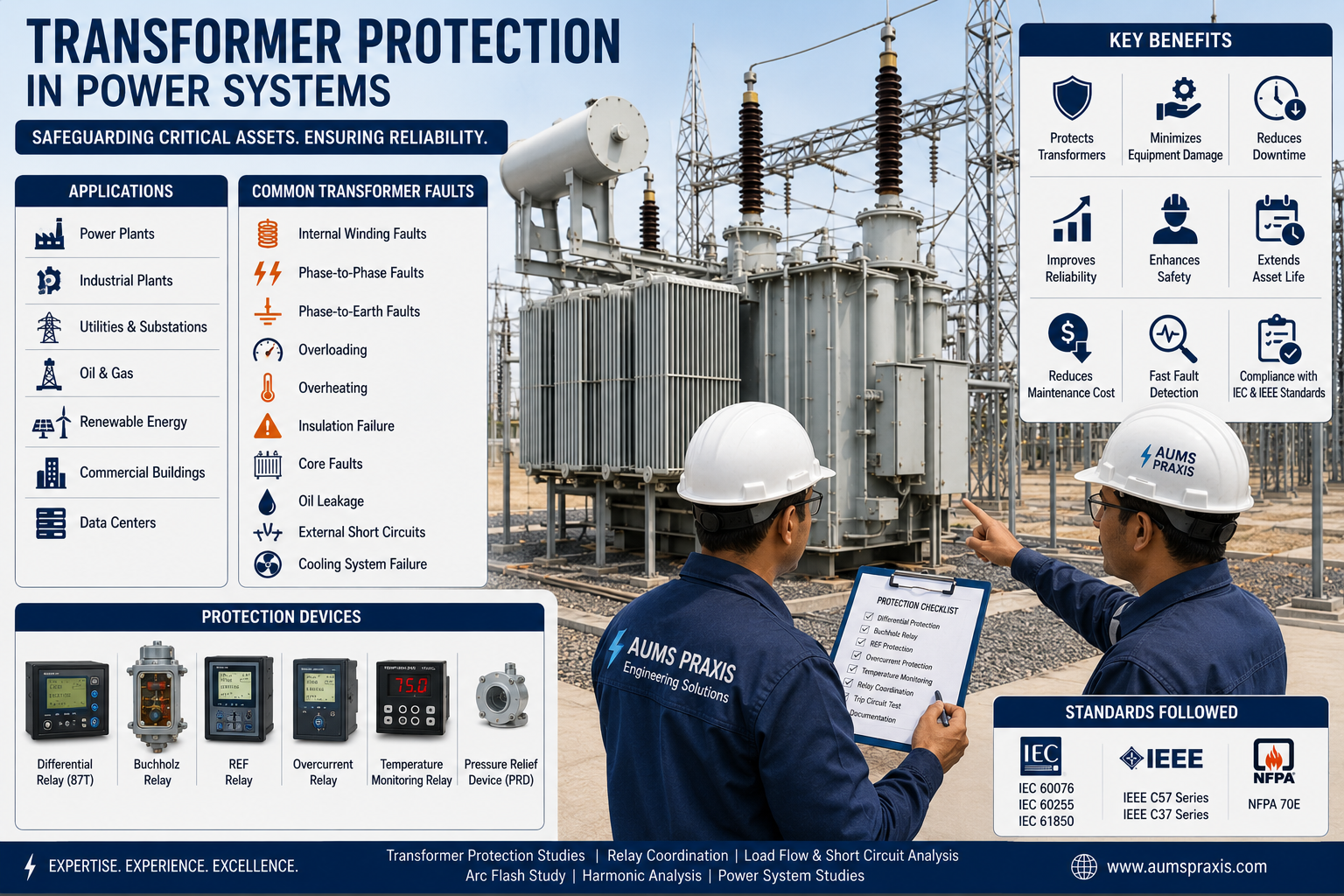
Various protective devices work together to monitor transformer operating conditions and isolate the transformer whenever unsafe conditions occur. Each device performs a specific function, thereby providing complete protection against different types of faults.
Major Protection Devices
- Differential Protection Relay (87T)
- Buchholz Relay
- Restricted Earth Fault (REF) Relay
- Overcurrent Relay (50/51)
- Earth Fault Relay (50N/51N)
- Overflux Protection (24)
- Temperature Monitoring Relay
- Pressure Relief Device (PRD)
- Oil Level Indicator
- Sudden Pressure Relay
Moreover, these protection devices operate together to detect internal faults, excessive temperature, abnormal pressure, and external electrical disturbances before permanent damage occurs.
Major Transformer Protection Schemes
Selecting the appropriate protection scheme depends on transformer capacity, voltage level, and application. Therefore, engineers combine several protection functions to achieve dependable and selective operation.
Differential Protection (87T)
Differential protection is the primary protection scheme for power transformers. It compares the current entering and leaving the transformer. Under normal operating conditions, both currents remain balanced. However, if an internal fault develops, the difference in current exceeds the relay setting, causing the circuit breaker to trip immediately.
Buchholz Protection
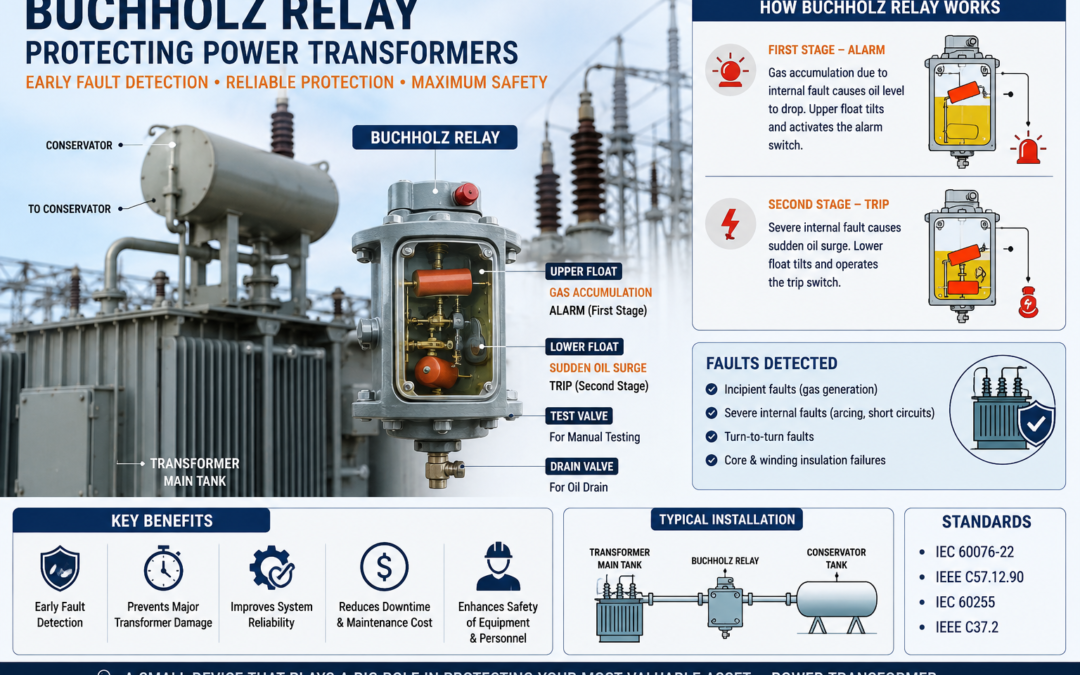
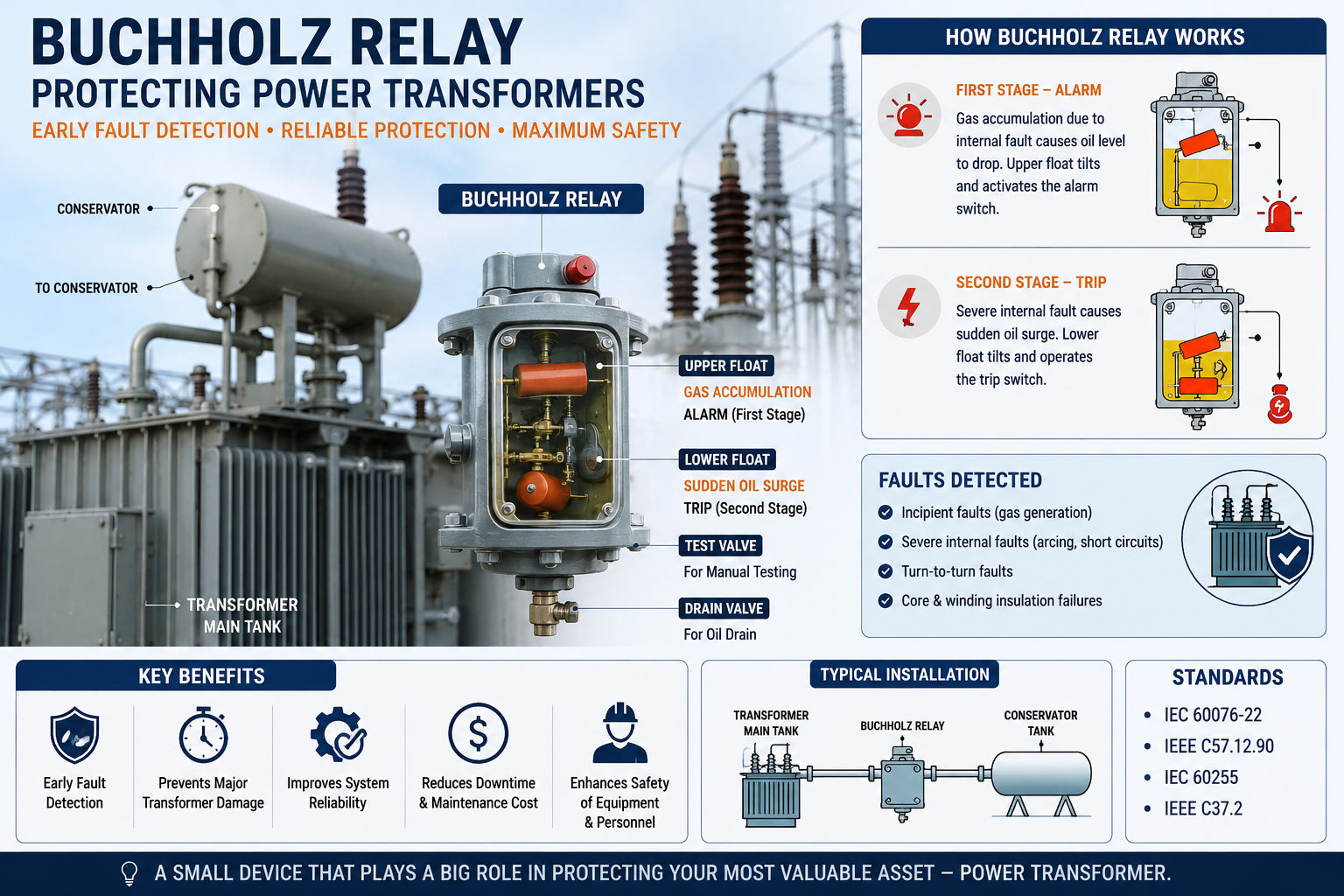
The Buchholz Relay is installed between the transformer tank and conservator in oil-filled transformers. It detects gas generated due to internal faults as well as sudden oil movement caused by severe failures. Consequently, it provides early warning and rapid protection against developing faults.
Restricted Earth Fault (REF) Protection
REF protection provides highly sensitive earth fault detection within the transformer winding zone. It responds much faster than conventional earth fault protection, making it particularly suitable for large power transformers.
Overcurrent and Earth Fault Protection
Overcurrent and earth fault relays protect transformers against external faults and excessive current caused by downstream equipment failures. Although these relays provide backup protection, they are essential for maintaining overall system security.
Engineering Methodology for Transformer Protection
A reliable protection system begins with a detailed engineering study and proper relay selection. Instead of installing protective devices based solely on transformer ratings, engineers evaluate system configuration, fault levels, transformer characteristics, and operating conditions. Consequently, the protection system becomes both dependable and selective.
Moreover, a well-planned engineering methodology minimizes false tripping while ensuring rapid fault clearance during abnormal conditions. As a result, transformer damage, production losses, and maintenance costs are significantly reduced.
Typical Engineering Workflow
- Review the latest Single Line Diagram (SLD).
- Collect transformer nameplate and test data.
- Verify CT and VT specifications.
- Perform Load Flow and Short Circuit Studies.
- Calculate transformer fault current levels.
- Select appropriate protection schemes.
- Configure relay settings.
- Perform protection coordination.
- Carry out relay testing and commissioning.
- Prepare the final protection report.
Therefore, following a systematic engineering process ensures that transformers remain protected throughout their operational life while maintaining overall power system reliability.
Software Used for Transformer Protection Studies
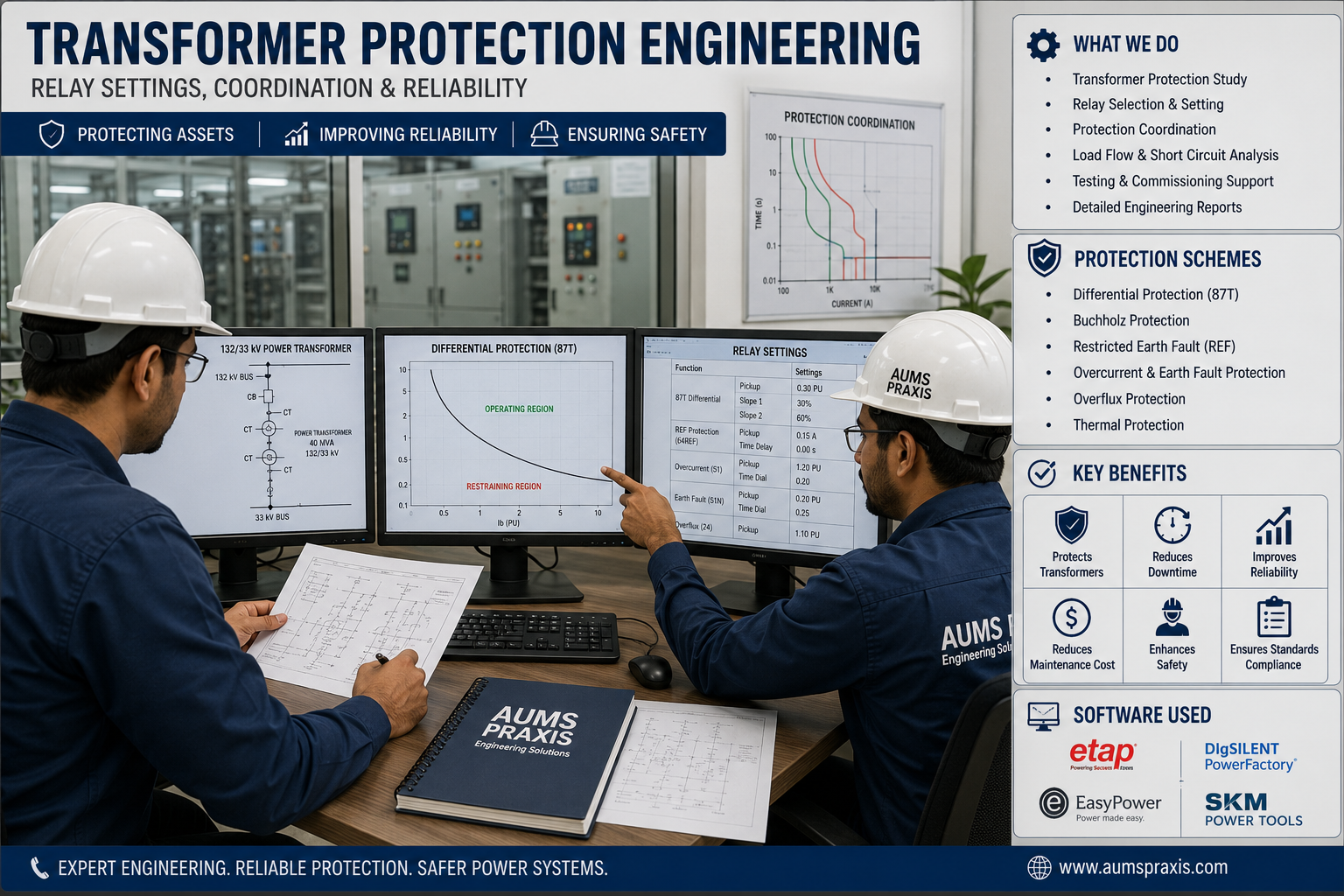
Modern transformer protection studies are performed using advanced power system analysis software. Compared to manual calculations, these software platforms provide greater accuracy, faster simulations, and detailed engineering reports. Furthermore, engineers can analyse different fault scenarios before implementing protection settings in the field.
Commonly Used Software
- ETAP
- DIgSILENT PowerFactory
- EasyPower
- SKM Power Tools
- CYME
- SEL AcSELerator QuickSet
- Siemens DIGSI
- ABB PCM600
These software solutions assist engineers in relay coordination, differential protection analysis, fault simulations, and commissioning activities. Consequently, they improve protection reliability while reducing engineering time.
International Standards for Transformer Protection
Transformer protection systems should comply with internationally recognized standards to ensure safety, consistency, and reliable operation. Therefore, engineers follow IEC and IEEE guidelines during system design, relay selection, testing, and commissioning.
Important Standards
- IEC 60076 – Power Transformers
- IEC 60255 – Measuring Relays and Protection Equipment
- IEC 61850 – Communication Networks and Systems
- IEEE C57 Series – Transformer Standards
- IEEE C37 Series – Protective Relays
- NFPA 70E – Electrical Safety in the Workplace
Additionally, compliance with these standards improves equipment reliability and supports long-term maintenance planning. Consequently, industries and utilities can operate their transformer assets with greater confidence.
Testing and Commissioning of Transformer Protection
Before a transformer is placed into service, all protection devices must be thoroughly tested and verified. Proper commissioning ensures that every relay, sensor, and circuit breaker operates correctly under both normal and fault conditions.
Typical Testing Activities
- Relay secondary injection testing.
- Differential protection testing.
- REF protection testing.
- Buchholz relay functional testing.
- Trip circuit verification.
- Circuit breaker operation testing.
- CT polarity and ratio testing.
- Protection logic verification.
Engineering Best Practice
The most effective transformer protection strategy combines Load Flow Analysis, Electrical Network Analysis, Harmonic Analysis, and relay coordination studies. This integrated approach improves transformer reliability, reduces unexpected failures, and extends equipment life.
Industrial Applications of Transformer Protection
Transformer Protection is essential for ensuring the safe and reliable operation of electrical power systems across various industries. Since transformers are critical assets, even a minor fault can lead to costly downtime and equipment damage. Therefore, industries implement advanced protection schemes to maintain continuous power supply and improve operational reliability.
Industries That Use Transformer Protection
- Power Generation Plants
- Transmission and Distribution Utilities
- Manufacturing Industries
- Oil & Gas Facilities
- Chemical and Petrochemical Plants
- Steel and Cement Industries
- Mining Operations
- Renewable Energy Projects
- Commercial Buildings
- Data Centers
Furthermore, transformer protection plays a vital role during plant expansion, substation modernization, and renewable energy integration. Consequently, organizations can reduce unplanned outages and improve the overall reliability of their electrical infrastructure.
Benefits of Transformer Protection
A well-designed protection system not only protects valuable assets but also improves the overall performance and reliability of the electrical network. Moreover, it reduces maintenance costs and enhances personnel safety.
Key Benefits
- Protects transformers from internal and external faults.
- Minimizes equipment damage.
- Reduces plant downtime.
- Improves system reliability.
- Extends transformer service life.
- Supports faster fault isolation.
- Enhances electrical safety.
- Reduces maintenance expenses.
- Improves operational efficiency.
- Ensures compliance with IEC and IEEE standards.
Common Challenges in Transformer Protection
Although modern protection systems are highly reliable, incorrect relay settings, outdated documentation, or improper CT selection can reduce protection performance. Therefore, regular testing, maintenance, and periodic review of protection settings are recommended.
Common Challenges
- Incorrect relay settings.
- CT saturation during high fault currents.
- Improper relay coordination.
- Outdated Single Line Diagrams.
- Poor maintenance practices.
- Ageing transformer insulation.
Frequently Asked Questions (FAQs)
1. What is Transformer Protection?
Transformer Protection is a combination of protective relays and monitoring devices used to detect faults and isolate transformers before severe damage occurs.
2. Which relay is most commonly used for transformer protection?
Differential Protection Relay (87T) is the primary protection relay used for detecting internal transformer faults.
3. What is the function of a Buchholz Relay?
A Buchholz Relay detects gas accumulation and sudden oil movement caused by internal faults in oil-filled transformers, providing early warning and trip signals.
4. Which standards are followed for transformer protection?
Common standards include IEC 60076, IEC 60255, IEC 61850, IEEE C57 Series, IEEE C37 Series, and NFPA 70E.
5. Why is relay coordination important?
Relay coordination ensures that only the faulty section is isolated, minimizing disruption to the remaining electrical system.
Related Engineering Services
- Power System Studies
- Electrical Network Analysis
- Load Flow Analysis
- Harmonic Analysis
- Arc Flash Study
- Electrical Engineering Consultancy
Conclusion
Transformer Protection is one of the most critical aspects of power system engineering. By implementing appropriate protection schemes, engineers can detect faults quickly, minimize equipment damage, and ensure uninterrupted power supply. Furthermore, integrating transformer protection with comprehensive Power System Studies improves operational efficiency, enhances electrical safety, and extends transformer life.
Whether you operate an industrial facility, utility substation, renewable energy plant, or commercial installation, a professionally designed Transformer Protection system helps ensure reliable and safe operation throughout the equipment lifecycle.
Related Power System Studies
Expand your knowledge of power system analysis by exploring our related engineering guides:
- Load Flow Analysis in Electrical Systems – Complete Guide
- Arc Flash Study in Electrical Systems – Complete Guide
- Electrical Network Analysis in Power Systems – Complete Guide
Looking for professional engineering consultancy? Explore our Power System Studies & Electrical Engineering Services .
Need Expert Transformer Protection Services?
Aums Praxis provides Transformer Protection Studies, Relay Coordination, Load Flow Analysis, Short Circuit Studies, Harmonic Analysis, Arc Flash Studies, and complete Power System Engineering solutions for industrial, commercial, and utility power systems up to 400 kV.
Contact Our Engineering Experts
Trackbacks/Pingbacks