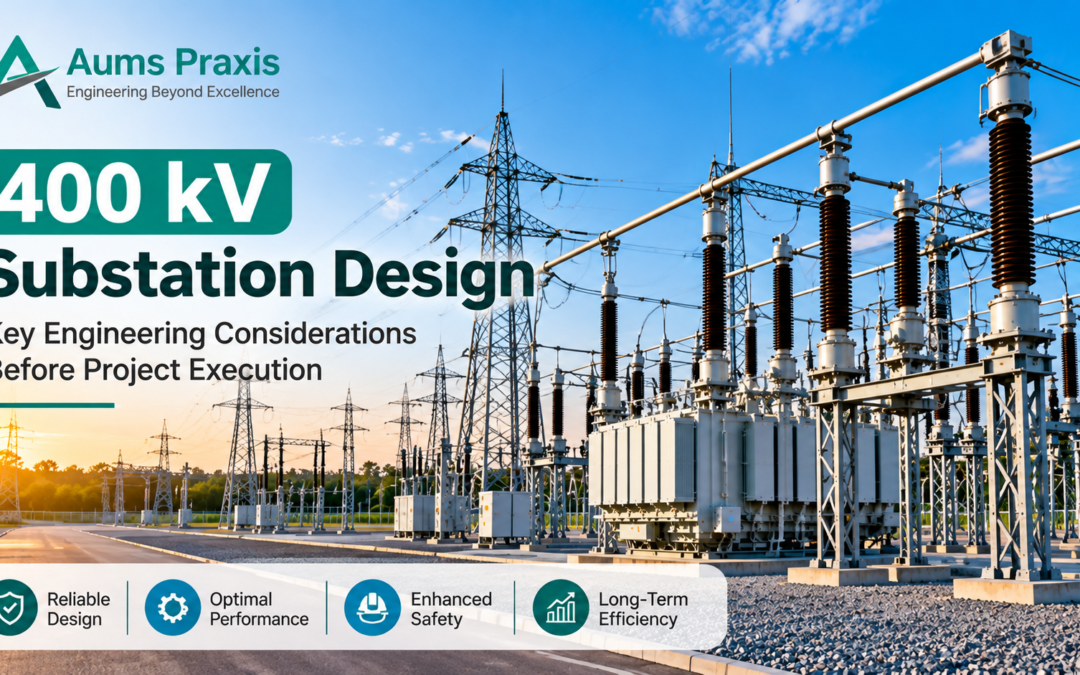
400 kV substation design requires detailed electrical engineering, careful equipment selection, coordinated protection systems, and comprehensive safety planning. As a critical part of the transmission network, a high-voltage substation must operate reliably under normal loading conditions and during electrical faults.
Before project execution begins, engineers must evaluate network requirements, fault levels, insulation coordination, earthing, cable systems, protection schemes, equipment clearances, and civil interfaces. These checks help identify design conflicts early, reduce commissioning risks, and support reliable operation throughout the substation's service life.
A coordinated engineering approach may include Load Flow Analysis, Short Circuit Studies, Protection Coordination, and Cable Design Services up to 400 kV. Together, these engineering activities help verify the proposed design against project requirements.
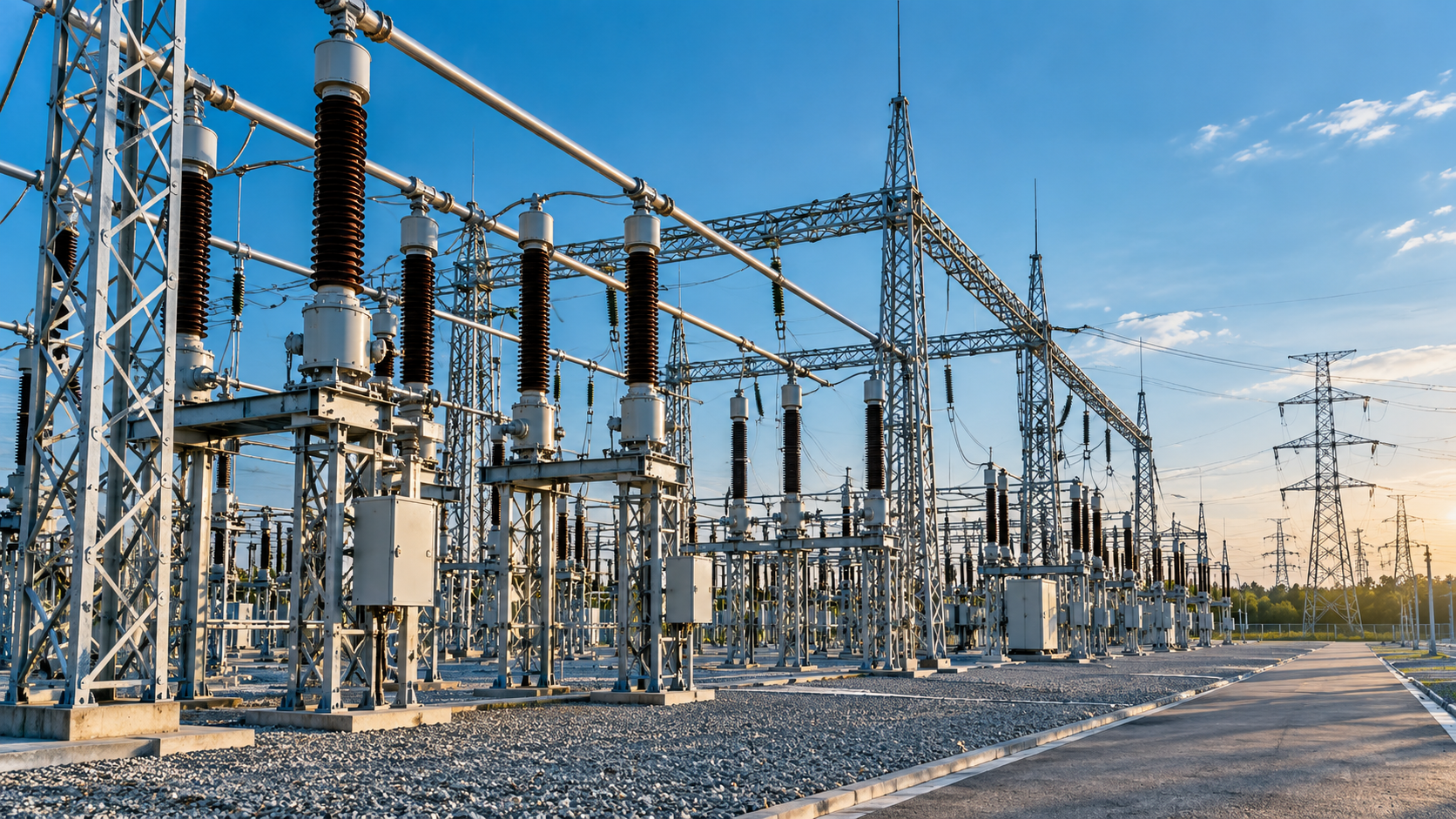
What Does 400 kV Substation Design Include?
400 kV substation design is the engineering process of planning and specifying the electrical equipment, connections, protection systems, control systems, earthing arrangements, and physical layout required for a high-voltage substation.
The design depends on the substation's purpose, transmission network configuration, expected loading, fault levels, site conditions, utility specifications, and applicable engineering standards. The selected arrangement must also accommodate maintenance, operational flexibility, and future expansion where required.
A complete design may include primary electrical systems, secondary protection and control systems, civil and structural interfaces, auxiliary supplies, cable routing, and communication infrastructure.
Why Is 400 kV Substation Design Important Before Project Execution?
Substation design affects equipment procurement, construction, system performance, safety, and long-term maintenance. If critical engineering checks are delayed until construction or commissioning, design changes may lead to additional costs, schedule delays, and equipment compatibility problems.
Engineers should therefore verify the main design requirements before equipment specifications are finalized and site installation begins.
- Verify electrical equipment ratings against calculated system conditions.
- Confirm the required busbar and switchgear configuration.
- Evaluate maximum and minimum short-circuit current levels.
- Coordinate protection relays and circuit breakers.
- Check insulation coordination and electrical clearances.
- Develop an appropriate earthing and bonding arrangement.
- Coordinate power cable routes and cable sizing.
- Review control, protection, and auxiliary supply requirements.
- Identify interfaces between electrical, civil, and structural designs.
- Allow for safe access, operation, and maintenance.
Addressing these points during engineering helps reduce the likelihood of major modifications after procurement or installation.
1. 400 kV Substation Design: Electrical Configuration and Single-Line Diagram
The electrical configuration is one of the first decisions in a 400 kV substation project. It defines how incoming transmission lines, busbars, transformers, circuit breakers, disconnectors, and outgoing feeders are interconnected.
The appropriate arrangement depends on reliability requirements, operating flexibility, land availability, maintenance strategy, project budget, and the consequences of equipment outages.
Key Electrical Configuration Checks
- Selection of a suitable busbar arrangement.
- Incoming and outgoing transmission line requirements.
- Transformer bay and feeder configuration.
- Isolation and maintenance arrangements.
- Operational flexibility during equipment outages.
- Provision for planned network expansion.
The single-line diagram should clearly represent the intended electrical connections and provide a consistent reference for equipment specifications, protection design, and subsequent engineering studies.
2. Power System Studies for 400 kV Substation Design
Power System Studies help engineers evaluate how a proposed substation will perform under different operating conditions. The results support equipment selection, protection settings, network planning, and verification of design assumptions.
The studies required for each project depend on network configuration, connected equipment, utility requirements, and the agreed engineering scope.
Load Flow Analysis
Load Flow Analysis evaluates bus voltages, active and reactive power flows, equipment loading, and system losses under specified operating conditions.
It helps engineers identify potential overloads, assess voltage performance, and evaluate normal, peak-demand, and relevant contingency scenarios.
Short Circuit Study
A Short Circuit Study calculates prospective fault currents at relevant locations in the electrical network. These results help verify that circuit breakers, switchgear, busbars, transformers, and associated equipment have suitable ratings for applicable fault conditions.
Protection Coordination Study
Protection Coordination Studies evaluate protective relay settings and operating sequences to support selective fault isolation. The objective is to disconnect the affected section while minimizing unnecessary interruptions to the remaining network.
Additional Power System Studies
- Insulation coordination and overvoltage assessment.
- Harmonic analysis, where relevant to connected equipment.
- Transient stability assessment, where required by network conditions.
- Earthing system analysis and safety verification.
- Cable sizing and voltage drop calculations.
- Arc flash assessment for applicable equipment and voltage levels.
The engineering scope should be agreed with the client or utility so that the necessary studies are completed using appropriate system data, assumptions, and acceptance criteria.
3. 400 kV Substation Design: High-Voltage Equipment Selection
Equipment selection for a 400 kV substation must consider electrical ratings, insulation requirements, environmental conditions, operating duty, maintainability, and compatibility with the overall system design.
Equipment should not be selected solely on the basis of nominal system voltage. Engineers must verify relevant ratings against calculated fault levels, operating conditions, utility specifications, and applicable standards.
Major Substation Equipment
- Power circuit breakers: Rated for the applicable voltage, continuous current, and fault-interruption duty.
- Disconnectors and earthing switches: Selected according to switching, isolation, and safety requirements.
- Current transformers: Specified for metering, protection, accuracy, and fault performance.
- Voltage transformers and CVTs: Selected to meet measurement, protection, and system interface requirements.
- Surge arresters: Applied according to insulation coordination and expected overvoltage conditions.
- Power transformers: Specified according to capacity, voltage ratio, impedance, cooling, and project requirements.
- Busbars and connectors: Designed for current-carrying capability, thermal limits, mechanical loads, and short-circuit forces.
- Insulators: Selected to meet electrical, mechanical, and environmental requirements.
Final equipment specifications should be coordinated with approved drawings, system studies, manufacturer data, and project-specific requirements.
4. Insulation Coordination in 400 kV Substation Design
Insulation coordination is a critical consideration in high-voltage substation design. Electrical insulation must withstand expected operating voltages and relevant temporary, switching, and lightning overvoltages.
Engineers assess insulation performance alongside equipment characteristics, surge protection, system grounding, and environmental conditions. The objective is to provide appropriate insulation withstand capability while maintaining a reliable design.
Important Insulation Design Checks
- Selection of appropriate equipment insulation levels.
- Assessment of switching and lightning overvoltage exposure.
- Coordination of surge arresters with protected equipment.
- Verification of phase-to-phase and phase-to-earth clearances.
- Consideration of altitude, pollution, and environmental conditions.
- Review of conductor movement and physical separation requirements.
Required electrical clearances must be established using applicable standards, utility specifications, equipment requirements, and site conditions. They should not be assumed from nominal voltage alone.
5. 400 kV Substation Layout and Physical Design
The physical layout translates the electrical design into a practical arrangement of equipment, structures, access routes, cable trenches, control facilities, and maintenance areas.
A well-coordinated layout supports safe operation, installation, inspection, and maintenance. It must also consider interfaces between primary equipment, civil structures, foundations, drainage, and auxiliary systems.
Substation Layout Considerations
- Equipment positioning and bay arrangement.
- Electrical clearances and safe working distances.
- Access for installation, inspection, and maintenance.
- Control building and auxiliary equipment locations.
- Cable trenches, ducts, and underground services.
- Equipment foundations and structural support interfaces.
- Drainage, site grading, and environmental conditions.
- Fire protection and emergency access provisions, where applicable.
- Space for future bays or additional equipment where required.
The layout should be reviewed with electrical, civil, structural, protection, and control teams before construction drawings are finalized.
6. Earthing and Grounding in 400 kV Substation Design
The substation earthing system is essential for managing fault-current paths and controlling dangerous touch and step voltages. Its design must consider site soil conditions, earth-fault current, fault duration, and the overall grounding arrangement.
Engineers evaluate the grounding grid, buried conductors, equipment bonding, metallic structures, and relevant connections to ensure that the earthing system meets applicable safety criteria.
Key Earthing Design Checks
- Soil resistivity assessment.
- Ground grid conductor sizing.
- Ground potential rise evaluation, where required.
- Touch and step voltage assessment.
- Bonding of equipment, structures, and metallic services.
- Connections to cable sheaths and other grounding systems.
- Verification against applicable utility and engineering requirements.
Earthing design should be based on project-specific calculations rather than a generic grid arrangement. The completed system must also be inspected and tested as required before energization.
7. Protection, Control and Automation for 400 kV Substations
Protection and control systems detect abnormal electrical conditions, initiate appropriate tripping actions, and provide information needed for substation operation. Their design must align with the primary equipment arrangement and the protection philosophy of the connected network.
Protection and Control Requirements
- Selection of suitable line, transformer, busbar, and breaker-failure protection schemes.
- Coordination of main and backup protection.
- Current transformer and voltage transformer circuit design.
- Trip circuit supervision and breaker control interfaces.
- Interlocking and operational safety logic.
- Alarm, indication, and event recording requirements.
- SCADA and communication interfaces.
- DC auxiliary supply and battery backup requirements.
Protection settings should be developed and verified using approved network data, equipment characteristics, and coordination studies. Relay configuration and functional testing should follow approved commissioning procedures.
8. Cable Design and Routing for 400 kV Substations
Cable systems connect protection panels, control equipment, auxiliary supplies, instrument transformers, and other substation equipment. Their design must consider electrical performance, installation conditions, environmental exposure, and the required separation of circuits.
Depending on the project scope, engineers may need to assess power cable sizing, control cable requirements, cable trench capacity, routing, voltage drop, and short-circuit withstand capability.
Important Cable Engineering Checks
- Current-carrying capacity and conductor sizing.
- Voltage drop under applicable operating conditions.
- Short-circuit thermal withstand capability.
- Installation method, grouping, and ambient conditions.
- Cable routing, bending radius, and termination interfaces.
- Separation of power, control, and communication circuits where required.
- Cable identification, termination schedules, and testing provisions.
For high-voltage transmission connections, cable systems may require additional studies based on cable technology, route length, installation method, bonding arrangement, and network requirements.
Explore Cable Design Services up to 400 kV for related high-voltage cable engineering requirements.
9. Engineering Standards for 400 kV Substation Design
A 400 kV substation design must follow the standards, utility specifications, statutory requirements, and project criteria applicable to its location and scope.
Depending on the equipment and design activity, relevant standards may cover high-voltage installations, insulation coordination, power transformers, high-voltage switchgear, protection relays, and earthing systems.
Standards to Review
- IEC 61936-1: Power installations exceeding 1 kV AC, subject to its scope and applicable edition.
- IEC 60071 series: Insulation coordination.
- IEC 60076 series: Power transformers.
- IEC 62271 series: High-voltage switchgear and controlgear.
- IEC 60255 series: Measuring relays and protection equipment.
- IEEE Std 80: Safety in AC substation grounding, where applicable.
- Utility specifications: Project-specific equipment, protection, testing, and documentation requirements.
The applicable edition and any national or utility-specific requirements should be confirmed at the start of the project. Listing a standard does not by itself establish compliance; the design must meet the relevant provisions.
For official information on international electrotechnical standards, visit the International Electrotechnical Commission (IEC).
10. Civil, Structural and Electrical Design Coordination
Successful substation execution depends on coordination between electrical engineering and the civil and structural design teams. Equipment foundations, gantries, support structures, cable trenches, access roads, and control buildings must match the approved electrical layout.
Coordination Activities
- Confirm equipment dimensions, weights, and foundation loads.
- Coordinate gantry and busbar support locations.
- Check cable trench routes against foundations and underground services.
- Review equipment access and maintenance clearances.
- Coordinate drainage and site grading with the electrical layout.
- Resolve drawing interfaces before construction release.
- Maintain consistency between equipment schedules and approved drawings.
Early interdisciplinary reviews help reduce site clashes, rework, procurement changes, and construction delays.
11. Pre-Execution Design Review and Documentation
Before construction and procurement proceed, the engineering team should review the design package for completeness, consistency, and compliance with agreed project requirements.
Documents Commonly Reviewed
- Approved design basis and technical specifications.
- Single-line diagrams and relevant schematics.
- Substation general arrangement and equipment layouts.
- Load flow and short-circuit study reports.
- Protection coordination and relay setting documentation.
- Equipment data sheets and technical schedules.
- Earthing and insulation coordination calculations.
- Cable schedules, sizing calculations, and routing drawings.
- Protection and control architecture and interface drawings.
- Inspection, testing, and commissioning requirements.
The exact document list depends on the contract, utility requirements, and project stage. Outstanding technical queries, design assumptions, and deviations should be recorded and resolved through the project's review and approval process.
12. Common Challenges in 400 kV Substation Projects
High-voltage substation projects involve multiple technical interfaces, detailed approval processes, and coordination between suppliers, contractors, consultants, and utilities. Several challenges can affect project delivery if they are not addressed early.
- Incomplete network data: Missing or outdated system information can affect engineering study results.
- Equipment specification mismatches: Inconsistent ratings or interfaces can lead to procurement and installation problems.
- Design coordination gaps: Electrical and civil drawings may conflict if reviews are delayed.
- Protection setting issues: Inadequate coordination can affect selective fault clearance.
- Late design changes: Changes after procurement or construction may increase cost and schedule pressure.
- Unclear approval requirements: Missing utility or statutory approvals can delay project milestones.
- Incomplete commissioning preparation: Unresolved design issues can affect testing and energization readiness.
A structured engineering review process, accurate project data, and timely coordination help teams manage these challenges before they affect execution.
Benefits of Proper 400 kV Substation Design
A coordinated and well-verified substation design provides technical, operational, and project-delivery benefits. It gives stakeholders a clearer basis for equipment procurement, installation, testing, and future maintenance.
- Improved electrical safety and reliability.
- Better alignment between equipment ratings and system requirements.
- Reduced risk of design conflicts during construction.
- Improved protection and fault isolation performance.
- More effective coordination between engineering disciplines.
- Better planning for operation and maintenance.
- Improved readiness for testing and commissioning.
- Reduced likelihood of avoidable rework and project delays.
- Clearer technical documentation and approval records.
- Better provision for future expansion where required.
Industries and Projects Requiring 400 kV Substation Design
400 kV substation engineering is relevant to transmission infrastructure and projects that require connection to high-voltage electricity networks. The design scope depends on the network operator, project configuration, and connection requirements.
- Utility transmission substations.
- Grid connection and transmission expansion projects.
- Power generation interconnections.
- Large renewable energy transmission connections.
- Industrial power infrastructure connected to high-voltage networks.
- Substation refurbishment and capacity expansion projects.
- Transmission network reinforcement schemes.
400 kV Substation Design: Frequently Asked Questions
What does 400 kV substation design include?
400 kV substation design may include electrical configuration, equipment selection, system studies, insulation coordination, earthing, protection and control, cable systems, physical layout, and coordination with civil and structural engineering. The exact scope depends on project requirements.
Which studies are required for a 400 kV substation?
Typical studies may include Load Flow Analysis, Short Circuit Studies, protection coordination, insulation coordination, and earthing system analysis. Harmonic, transient stability, and other studies may also be required depending on the network, connected equipment, and utility specifications.
Why is short-circuit analysis important in substation design?
Short-circuit analysis establishes prospective fault currents at relevant points in the network. Engineers use the results to verify equipment fault ratings and support protection system design.
Why is earthing design necessary for a 400 kV substation?
Earthing design provides grounding and bonding paths and helps control touch and step voltages during earth faults. The design must be based on site conditions, fault-current data, and applicable safety criteria.
Which standards apply to 400 kV substation design?
Applicable standards depend on the equipment, engineering activity, project location, and utility requirements. Relevant IEC and IEEE standards may cover high-voltage installations, insulation coordination, switchgear, transformers, protection, and grounding. The project team should confirm the applicable editions and requirements.
What should be checked before substation construction begins?
Before construction, the project team should review the approved design basis, system study results, equipment specifications, general arrangement, protection and control interfaces, earthing design, cable routing, civil interfaces, and required approvals. Outstanding technical issues should be resolved or formally managed.
Can early engineering reviews reduce project delays?
Yes. Reviewing equipment interfaces, design calculations, layouts, and documentation before procurement and construction helps identify conflicts earlier. This can reduce avoidable rework and support smoother project execution.
Conclusion
400 kV substation design requires a coordinated approach to electrical studies, equipment selection, insulation coordination, earthing, protection and control, cable systems, physical layout, and interdisciplinary engineering. Each element must be checked against project requirements and applicable standards before the design is released for execution.
Comprehensive engineering reviews help identify technical issues early, improve coordination between project teams, and support reliable operation after commissioning. By resolving critical design questions before procurement and construction, utilities, EPC contractors, and project developers can reduce avoidable rework and improve project readiness.
Ultimately, a well-coordinated design provides the technical foundation for safe, reliable, and maintainable high-voltage substation infrastructure.
Related Engineering Services
Explore these related Aums Praxis engineering services for additional information:
- Electrical & Substation Plant Design Services
- Cable Design Services up to 400 kV
- Load Flow Analysis in Electrical Systems
- Short Circuit Calculation for Electrical Systems
- Relay Coordination Study
- Electrical Network Analysis
Planning a 400 kV Substation Project?
Aums Praxis provides electrical engineering consultancy for high-voltage infrastructure, including substation design, cable design, and power system engineering. Discuss your project scope and technical requirements with our team.
Contact our team to discuss your engineering requirements and project objectives.
Contact Us Now