
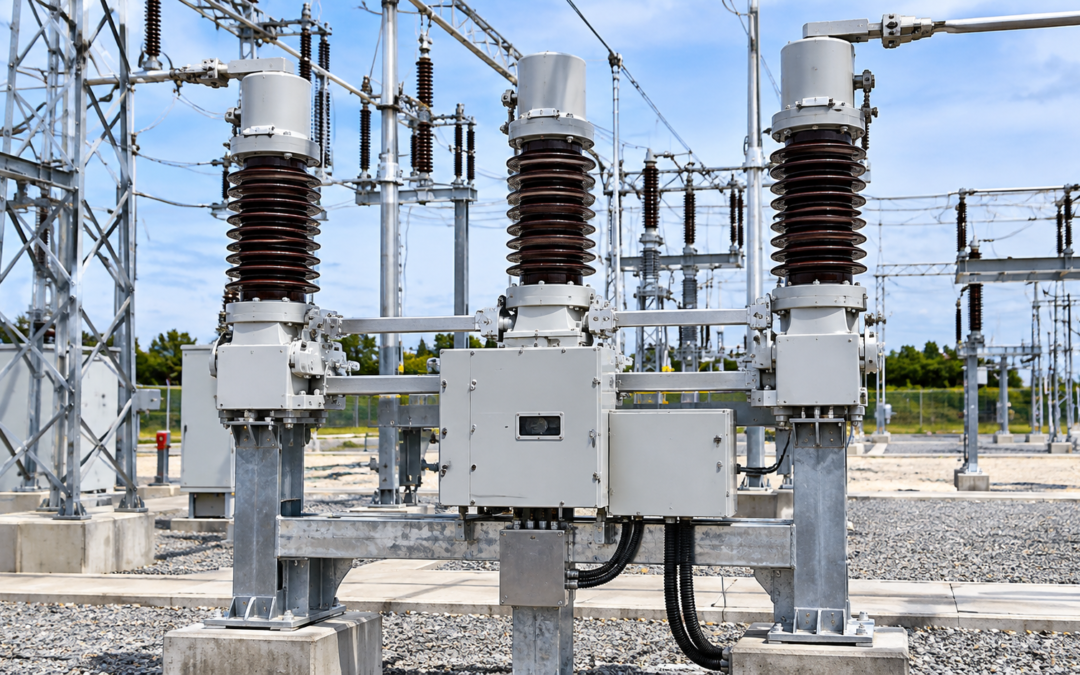
High Voltage Circuit Breaker Selection is an important part of electrical substation engineering. A correctly selected circuit breaker carries normal operating current and interrupts fault current safely when required. Therefore, engineers evaluate rated voltage, breaking capacity, insulation levels and operating conditions before finalising equipment specifications.
In high-voltage networks, circuit breakers protect transformers, busbars, transmission lines and other electrical equipment. They also support reliable system operation by isolating faulty sections quickly. As a result, proper selection helps improve electrical safety, equipment protection and network availability.
Furthermore, engineers must consider the complete electrical system rather than selecting a breaker using voltage rating alone. Short-circuit studies, protection coordination, transient recovery voltage and installation conditions all influence the final specification.
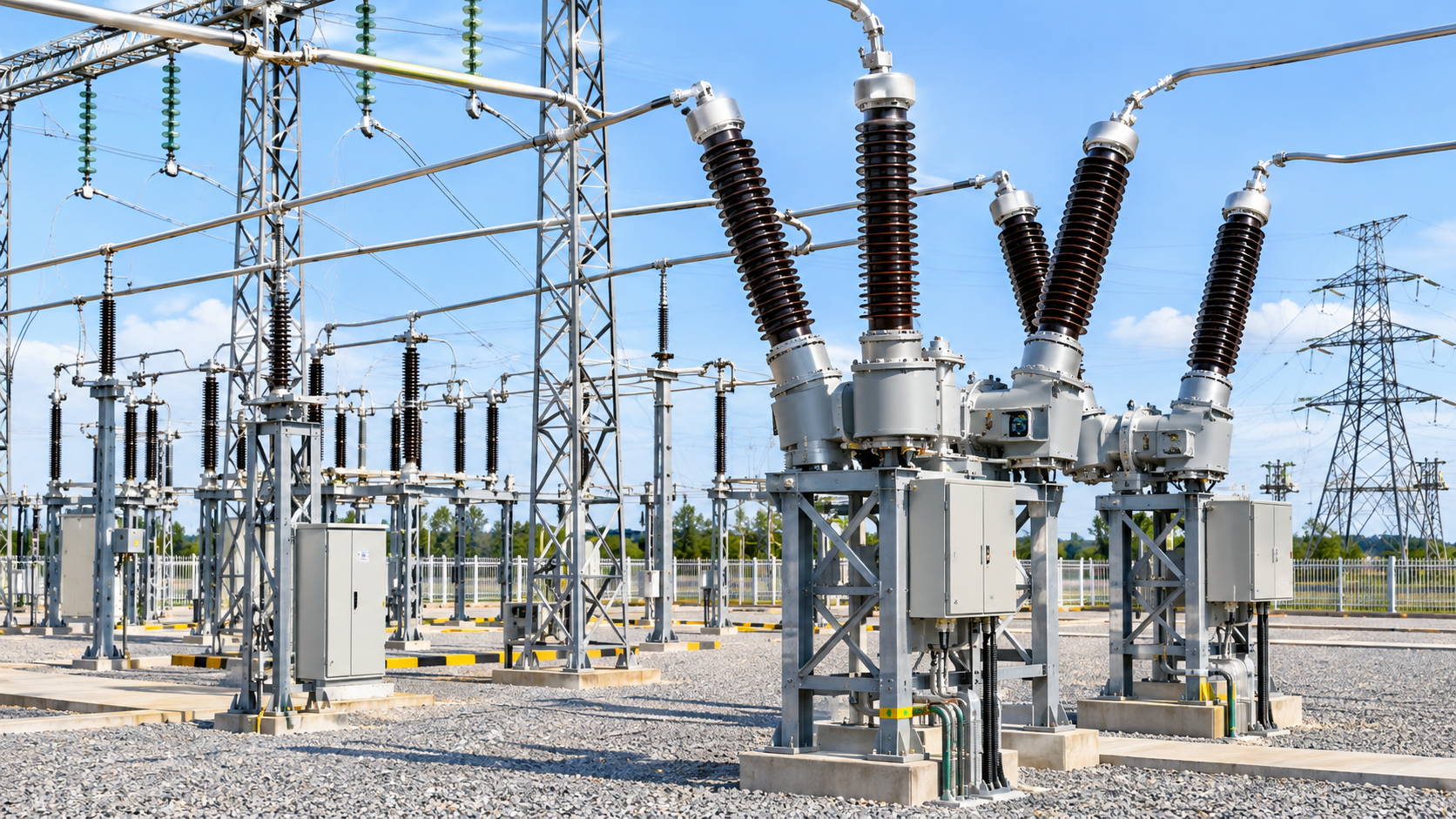 alt="High voltage circuit breakers installed in an electrical substation"
title="High Voltage Circuit Breaker Selection"
loading="lazy">
Table of Contents
- Understanding High Voltage Circuit Breakers
- How a Circuit Breaker Works
- High Voltage Circuit Breaker Selection Parameters
- Rated Voltage and Insulation Levels
- Rated Normal Current
- Breaking Capacity and Short-Circuit Current
- Making Current and Peak Withstand Current
- Transient Recovery Voltage
- Types of High Voltage Circuit Breakers
- Applicable IEC Standards
- Engineering Studies and Design Checks
- Common Selection Mistakes
- Circuit Breaker Selection Checklist
- Frequently Asked Questions
Understanding High Voltage Circuit Breakers
A high-voltage circuit breaker is a switching device designed to make, carry and interrupt current under specified operating conditions. It can interrupt normal load current as well as fault current within its rated capabilities.
In addition, circuit breakers work with protective relays and instrument transformers. When a protection system identifies a fault, it sends a trip command to the breaker. The breaker then opens its contacts and isolates the affected circuit.
These devices are commonly installed in:
- Transmission and distribution substations.
- Power generation facilities.
- Industrial electrical networks.
- Transformer and feeder protection systems.
- High-voltage switchyards and grid interconnections.
How a Circuit Breaker Works
During normal operation, the breaker contacts remain closed and carry electrical current. However, when a fault occurs, the protection relay detects abnormal conditions and issues a trip signal.
After receiving the signal, the operating mechanism separates the contacts. An electrical arc may form between them. The breaker uses its interrupting medium and contact design to extinguish this arc and establish insulation between the contacts.
Consequently, the faulty section becomes isolated while the remaining network can continue operating, subject to the protection scheme and system configuration.
High Voltage Circuit Breaker Selection Parameters
High Voltage Circuit Breaker Selection requires several electrical, mechanical and environmental checks. Each parameter serves a different purpose. Therefore, engineers should review the complete duty rather than relying on a single nameplate rating.
| Selection Parameter | Engineering Purpose |
|---|---|
| Rated voltage | Defines the maximum system voltage class for the equipment. |
| Rated normal current | Confirms continuous current-carrying capability. |
| Rated breaking current | Defines the symmetrical short-circuit current interruption capability. |
| Making current | Addresses the peak current associated with closing onto a fault. |
| Short-time withstand current | Defines the current the breaker can withstand for a specified duration. |
| Insulation level | Addresses power-frequency and impulse voltage withstand requirements. |
| Operating sequence | Confirms suitability for the required switching duty. |
| Transient recovery voltage | Checks the voltage stress across breaker contacts after interruption. |
Rated Voltage and Insulation Levels
Rated voltage is one of the first considerations in high-voltage circuit breaker selection. The selected equipment must match the applicable highest voltage for the system and its insulation coordination requirements.
Engineers also assess power-frequency withstand voltage and lightning impulse withstand voltage. Depending on the installation, switching impulse withstand capability may also be relevant.
Important voltage considerations
- Nominal system voltage.
- Highest voltage for equipment.
- Power-frequency withstand level.
- Lightning impulse withstand level.
- Switching impulse withstand requirements, where applicable.
- System grounding and overvoltage conditions.
Moreover, insulation coordination should consider surge arrester characteristics and expected network overvoltages. These checks help ensure that the breaker insulation is suitable for the actual installation.
Rated Normal Current
Rated normal current represents the current that a circuit breaker can carry continuously under specified service conditions. The rating should suit the expected operating load and the connected equipment.
For example, transformer incomers, bus couplers and outgoing feeders may have different continuous current requirements. Engineers should consider load forecasts, permissible overloads and future expansion when preparing equipment specifications.
Additionally, ambient temperature, enclosure arrangement and installation conditions can influence equipment performance. Always check the manufacturer's declared ratings and applicable correction requirements.
Breaking Capacity and Short-Circuit Current
Breaking capacity is a critical factor in high-voltage circuit breaker selection. It describes the circuit breaker's ability to interrupt fault current under specified conditions.
Engineers normally obtain prospective fault levels from short-circuit studies. These calculations assess the contribution of generators, transformers, motors and network connections to the fault current.
Therefore, the selected breaker must have an adequate rated short-circuit breaking current for the calculated duty. The assessment should also consider future network changes that could increase fault levels.
Why short-circuit studies matter
- They establish maximum prospective fault current.
- They help verify breaker interrupting capability.
- They support equipment withstand checks.
- They provide inputs for protection coordination.
- They help assess changes in network configuration.
Learn more about Power System Studies and their role in electrical network design.
Making Current and Peak Withstand Current
Making current is associated with the peak current that a circuit breaker may experience when closing onto an existing fault. This duty differs from the symmetrical breaking current because it includes the effects of the DC component and the system X/R ratio.
Similarly, peak withstand current is important when assessing the mechanical strength of equipment during short-circuit conditions. Engineers should verify that the specified ratings are compatible with the expected network duty.
Transient Recovery Voltage in Circuit Breaker Selection
Transient Recovery Voltage (TRV) is the transient voltage that appears across circuit breaker contacts after current interruption. Its magnitude and rate of rise can influence the interruption performance of the breaker.
However, TRV requirements depend on the type of fault, network configuration, equipment location and switching conditions. Therefore, engineers should evaluate the relevant duty when preparing specifications for critical high-voltage applications.
In addition, manufacturer test capabilities and applicable standards should be checked to confirm that the proposed breaker is suitable for the specified TRV conditions.
Types of High Voltage Circuit Breakers
Different circuit breaker technologies are used across electrical networks. The choice depends on voltage class, application, operating requirements, maintenance strategy and manufacturer design.
1. SF6 Circuit Breakers
SF6 circuit breakers use sulphur hexafluoride gas as an insulating and arc-quenching medium. They have been widely used in high-voltage and extra-high-voltage substations because of their established interruption performance and compact designs.
However, SF6 is a potent greenhouse gas. Therefore, gas handling, leakage monitoring, recovery and environmental requirements must be considered during equipment selection and operation.
2. Vacuum Circuit Breakers
Vacuum circuit breakers interrupt current inside sealed vacuum interrupters. They are commonly used in medium-voltage applications and selected voltage classes according to the manufacturer's design and ratings.
3. Air-Insulated and Alternative Technologies
Air-insulated switching arrangements and newer alternative insulation technologies may be suitable for specific applications. Engineers should assess the complete equipment design, environmental performance, maintenance requirements and tested operating capabilities before selecting a technology.
| Technology | Typical Consideration |
|---|---|
| SF6 | Established high-voltage applications; gas management is important. |
| Vacuum | Commonly applied in medium-voltage switching systems. |
| Alternative insulation | Requires assessment of tested performance and application suitability. |
Applicable IEC Standards for High Voltage Circuit Breakers
International standards provide a common basis for equipment ratings, testing, performance and specification. IEC 62271-1 covers common specifications for high-voltage switchgear and controlgear. IEC 62271-100 addresses alternating-current circuit-breakers.
Depending on the project, engineers should also review related standards for insulation coordination, instrument transformers, protection and installation requirements.
For official technical information, refer to the International Electrotechnical Commission (IEC) standards catalogue.
Engineering Studies for High Voltage Circuit Breaker Selection
Reliable equipment selection depends on coordinated engineering studies. These studies provide the technical inputs required to verify breaker ratings and protection performance.
Short-Circuit Analysis
Short-circuit analysis establishes fault current levels at different network locations. It helps engineers verify the interrupting and withstand capabilities of circuit breakers.
Protection Coordination Study
Protection coordination checks whether protective devices operate in the intended sequence. It supports selective fault isolation and helps reduce unnecessary interruptions.
Explore the Relay Coordination Study for more information.
Insulation Coordination Study
Insulation coordination evaluates expected overvoltages and the withstand capability of electrical equipment. It also supports appropriate surge arrester selection and insulation level assessment.
Load Flow Analysis
Load flow studies help engineers understand normal operating conditions, voltage profiles and power flows. These results provide wider context for substation equipment planning.
For integrated engineering support, visit the Aums Praxis engineering services page.
Common Mistakes in Circuit Breaker Selection
Even when the basic electrical ratings appear suitable, overlooking application-specific requirements can create problems during operation. Engineers should avoid the following common mistakes:
- Selecting a breaker without checking the latest short-circuit study.
- Considering nominal voltage but overlooking the highest voltage for equipment.
- Ignoring transient recovery voltage requirements.
- Overlooking making current and short-time withstand ratings.
- Failing to review the required operating sequence.
- Ignoring ambient conditions and installation requirements.
- Not coordinating breaker characteristics with the protection system.
- Using outdated manufacturer data or standard editions.
Consequently, a structured technical review can reduce specification errors and improve confidence in equipment selection.
High Voltage Circuit Breaker Selection Checklist
Before approving a circuit breaker specification, engineers can use the following checklist:
- Confirm nominal and highest system voltage.
- Verify insulation withstand levels.
- Review continuous current requirements.
- Confirm short-circuit breaking current.
- Check making current and short-time withstand ratings.
- Assess transient recovery voltage requirements.
- Verify operating sequence and mechanism requirements.
- Review control voltage and auxiliary circuits.
- Check environmental and installation conditions.
- Confirm compliance with applicable IEC standards.
- Review manufacturer test reports and technical data.
- Coordinate the breaker with the overall protection scheme.
Frequently Asked Questions
1. What is the most important factor in high voltage circuit breaker selection?
There is no single factor that determines suitability. Rated voltage, continuous current, breaking capacity, insulation levels and switching duties must all match the application.
2. Why is short-circuit breaking capacity important?
It confirms whether the breaker can interrupt the prospective fault current under its specified test and operating conditions. An inadequate rating can compromise system safety and reliability.
3. What is transient recovery voltage?
Transient Recovery Voltage is the transient voltage appearing across breaker contacts after current interruption. Its characteristics are important when assessing interruption capability.
4. Which standards are relevant to high voltage circuit breakers?
IEC 62271-1 and IEC 62271-100 are important references for high-voltage switchgear and circuit breakers. The project may require additional standards depending on the application.
5. Are SF6 circuit breakers still used in substations?
SF6 circuit breakers remain installed in many substations. However, environmental regulations, gas management requirements and alternative technologies should be considered during new equipment selection.
6. Why are engineering studies required before selecting a circuit breaker?
Short-circuit, protection coordination and insulation coordination studies provide essential information about electrical stresses and operating duties. They help engineers verify that the selected breaker suits the network.
Conclusion
High Voltage Circuit Breaker Selection is a coordinated engineering activity that requires more than checking a voltage rating. Engineers must evaluate continuous current, short-circuit duty, insulation performance, transient recovery voltage and operating requirements.
Furthermore, short-circuit analysis, protection coordination and insulation coordination provide important technical inputs for the final equipment specification. A structured approach helps improve equipment suitability, operational reliability and electrical safety.
Need Support with High Voltage Substation Engineering?
Aums Praxis provides electrical engineering design and consultancy services, including power system studies, protection coordination, electrical design and substation engineering for industrial and infrastructure projects.
Contact Aums Praxis