
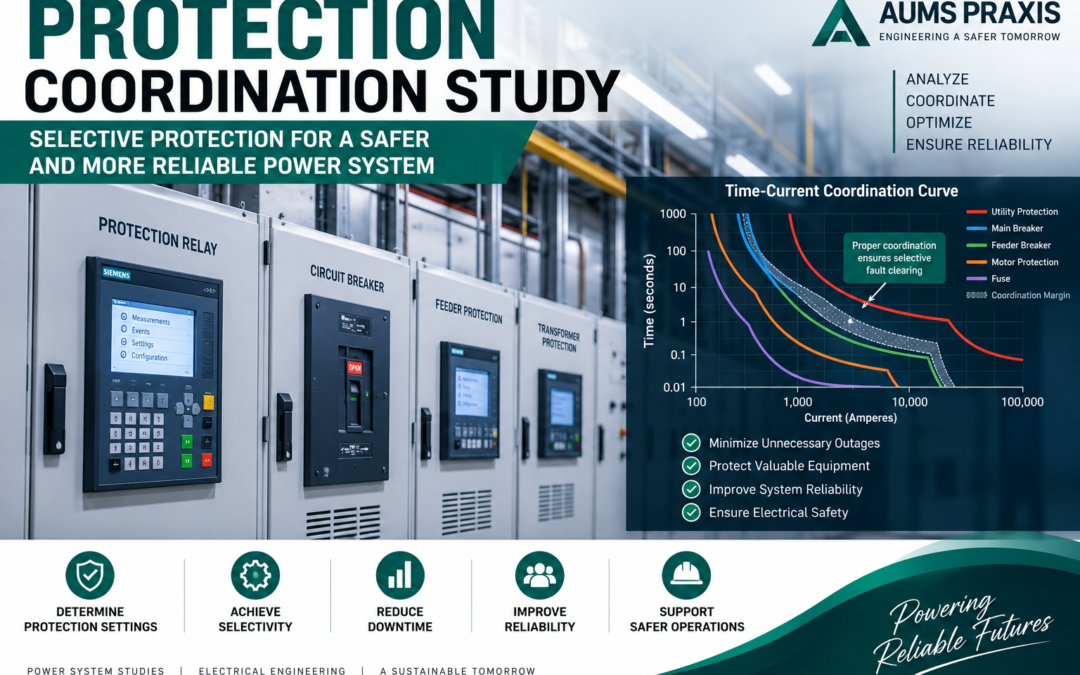
Protection Coordination Study is an important part of electrical power system design and protection engineering. It helps engineers determine suitable protective device settings so that faults can be detected and cleared quickly while minimizing unnecessary interruption to healthy parts of the electrical network.
Modern industrial and commercial electrical systems contain transformers, generators, motors, switchgear, feeders, cables, and various protection devices. Therefore, proper coordination between these devices is essential for reliable system operation. A detailed study helps engineers understand how protective devices respond to different fault conditions and operating scenarios.
Furthermore, Protection Coordination Study works closely with Short Circuit Analysis, Load Flow Analysis, Arc Flash Studies, and equipment protection design. As a result, organizations can develop a safer and more reliable electrical protection system before commissioning or modifying an installation.
- Protection Coordination Study: What Is It?
- Why is Protection Coordination Important?
- Protection Devices Covered
- Key Protection Coordination Principles
- Data Required for the Study
- Protection Coordination Study Process
- Time-Current Characteristic Curves
- Role of Short Circuit Analysis
- Relationship with Arc Flash Studies
- Common Coordination Problems
- Benefits of Protection Coordination
- Applications
- Frequently Asked Questions
- Related Engineering Services
- Conclusion
What Is Protection Coordination Study?
A Protection Coordination Study evaluates the operation and settings of protective devices throughout an electrical power system. Engineers analyze circuit breakers, fuses, relays, and other protection equipment to determine how they should respond when an abnormal condition or electrical fault occurs.
The main objective is to ensure that the protective device closest to the fault operates first whenever practical. Therefore, a fault on a downstream feeder should normally be cleared by the appropriate downstream protection without unnecessarily tripping upstream equipment.
For example, if a fault occurs on a motor feeder, the associated feeder protection should ideally clear the fault before the main switchboard breaker operates. This approach helps maintain power supply to unaffected sections of the facility.
Consequently, proper coordination improves system selectivity, reliability, and operational continuity while helping engineers establish appropriate protection settings.

Why is Protection Coordination Important?
Electrical faults can create high currents that may damage cables, transformers, switchgear, motors, generators, and other equipment. Therefore, protection systems must detect abnormal conditions and isolate the affected section within an appropriate time.
However, simply installing protective devices is not enough. Their characteristics and settings must work together across the electrical network. Otherwise, a relatively small downstream fault could unnecessarily trip a major upstream breaker and interrupt power to a much larger part of the facility.
- Achieve selective protection
- Reduce unnecessary power interruptions
- Protect electrical equipment from fault damage
- Establish suitable protective device settings
- Improve system reliability
- Evaluate breaker and relay operating characteristics
- Support safe electrical system operation
- Coordinate upstream and downstream protection
- Support Arc Flash Study requirements
- Improve maintenance and protection planning
Protection Devices Covered
A Protection Coordination Study can include several types of protective devices depending on the electrical system configuration. Engineers evaluate the characteristics and settings of each device and then compare their operation with other devices in the protection chain.
Circuit Breakers
Circuit breakers protect electrical circuits from abnormal current conditions. Engineers evaluate parameters such as pickup current, short-time settings, instantaneous settings, and time delays where applicable. Therefore, proper breaker coordination is important for maintaining selectivity.
For additional information on low-voltage circuit-breaker requirements, engineers can refer to the official IEC 60947-2:2024 standard for circuit-breakers.
Protective Relays
Protective relays monitor electrical quantities and initiate circuit breaker operation when defined protection conditions occur. Furthermore, engineers can coordinate relay pickup values and operating times with downstream and upstream devices.
Fuses
Fuses provide overcurrent protection and operate according to their time-current characteristics. Consequently, engineers should evaluate fuse characteristics alongside breaker and relay curves when developing the overall protection scheme.
Motor Protection Devices
Motors can experience starting currents that are significantly higher than their normal operating current. Therefore, engineers must consider motor starting characteristics when selecting and coordinating motor protection devices.
Transformer Protection
Transformers require protection against conditions such as overloads and short circuits. Engineers evaluate transformer ratings, fault levels, inrush considerations, and associated protective devices when developing a coordinated protection system.
Key Protection Coordination Principles
Several engineering principles guide the development of a coordinated protection system. Although the exact approach depends on the network, the following principles are commonly considered.
Selectivity
Selectivity means that the protective device closest to the fault should operate first whenever practical. Therefore, only the affected portion of the electrical system is disconnected while healthy sections remain energized.
Speed of Operation
Protection should clear faults quickly enough to limit equipment damage and reduce electrical hazards. However, engineers must balance fast operation with coordination requirements between different protective devices.
Sensitivity
A protection device should detect relevant fault conditions without responding unnecessarily to normal operating conditions. For example, motor starting current should not cause inappropriate operation of the motor feeder protection.
Reliability
Protection systems should operate correctly when required and remain stable during normal system conditions. Consequently, engineers consider device characteristics, settings, equipment ratings, and system operating scenarios during the study.
Backup Protection
If the primary protection fails to clear a fault, an upstream device may provide backup protection. Therefore, coordination should also consider the operating relationship between primary and backup protective devices.
Data Required for the Study
Accurate input data is essential for a reliable Protection Coordination Study. Engineers normally collect electrical system information from design documents, equipment datasheets, manufacturer information, and existing site records.
- Single Line Diagrams
- Transformer ratings and impedance
- Generator data
- Motor ratings and starting characteristics
- Cable sizes and lengths
- Switchgear ratings
- Circuit breaker information
- Protective relay models and characteristics
- Fuse ratings and curves
- CT ratios and characteristics
- Utility fault level information
- Existing protection settings
- Operating configurations
Furthermore, engineers should verify the quality and consistency of the available data before developing the study model. Incorrect equipment ratings or protection settings can affect the accuracy of the final coordination results.
Protection Coordination Study Process
A professional Protection Coordination Study follows a structured engineering process. The exact workflow varies according to the size and complexity of the electrical network. Nevertheless, engineers commonly follow the stages below.
1. Review the Electrical Network
Engineers review the Single Line Diagram and identify transformers, generators, switchboards, feeders, motors, cables, and other major electrical equipment. In addition, they identify the existing protection philosophy and network operating configurations.
2. Collect Equipment Data
Engineers collect ratings and technical information for electrical equipment and protective devices. Therefore, the study model can accurately represent the actual or proposed installation.
Protection Coordination Study
Short Circuit Analysis for Protection Coordination Study
Engineers determine fault current levels at relevant locations within the network. These results provide important input for protective device selection and coordination. Consequently, Protection Coordination Study and Short Circuit Analysis are closely connected.
4. Review Protective Devices
Engineers identify the circuit breakers, relays, fuses, and other protective devices installed throughout the network. They then review the available device characteristics and operating ranges.
5. Develop Time-Current Curves
Engineers plot the operating characteristics of protective devices on time-current curves. These curves help them compare the response of upstream and downstream devices over a range of fault currents.
6. Establish Protection Settings
Based on the study results, engineers develop suitable protection settings. These settings may include pickup values, time delays, instantaneous protection, short-time protection, and other applicable parameters.
7. Check Coordination
Engineers compare the protective device curves and operating times to determine whether suitable selectivity exists. However, they also consider equipment damage limits, conductor capabilities, transformer protection requirements, and system operating conditions.
8. Review Arc Flash Impact
Protection settings can affect the clearing time used in Arc Flash Analysis. Therefore, engineers should review the coordination results together with arc flash requirements where applicable.
9. Prepare the Final Report
Finally, engineers document the study assumptions, system model, fault levels, protection settings, coordination curves, findings, and recommendations. As a result, the organization receives a practical reference for protection implementation and future maintenance.
Time-Current Characteristic Curves
Time-current characteristic curves are an important part of protection coordination. These curves show the relationship between fault current magnitude and the time required for a protective device to operate.
Engineers compare the curves of multiple protective devices to determine whether the downstream device can operate before the upstream device. Therefore, the curves provide a visual method for assessing selectivity and coordination.
For example, a downstream feeder breaker should generally operate before its upstream breaker for a fault within the feeder protection zone. This arrangement helps limit the outage to the smallest practical portion of the network.
Furthermore, engineers review the curves against equipment thermal limits, conductor damage characteristics, transformer requirements, and other applicable constraints. Consequently, coordination becomes a balance between protection speed, selectivity, and equipment protection.
Role of Short Circuit Analysis
Short Circuit Analysis provides the fault current information required for protection studies. Engineers use calculated fault levels to understand the current that protective devices may experience during different fault conditions.
Therefore, a Protection Coordination Study should use appropriate short circuit results for the relevant system configuration. Fault levels can vary depending on utility supply conditions, generator operation, transformer configuration, and other network parameters.
In addition, engineers can use short circuit results to verify whether switchgear and protective equipment have suitable interrupting capabilities. This combined assessment supports safer and more reliable electrical system design.
Relationship with Arc Flash Studies
Protection Coordination and Arc Flash Studies are closely related because protective device operating times can influence incident energy calculations. Faster fault clearing can reduce the duration of an arc flash event under applicable conditions.
However, engineers should not change protection settings solely to achieve a lower arc flash result without considering coordination, equipment protection, and system reliability. Therefore, the final protection strategy should balance all relevant engineering requirements.
Furthermore, an integrated approach can help organizations understand the relationship between fault current, protective device operation, incident energy, and electrical safety.
Common Coordination Problems
Electrical systems can experience several protection coordination problems when device settings or system characteristics do not align correctly. Early identification of these issues can help prevent unnecessary outages and protection failures.
Overlapping Protection Curves
When protective device curves overlap significantly, the upstream and downstream devices may not provide sufficient selectivity. Consequently, a downstream fault could cause unnecessary operation of an upstream device.
Incorrect Pickup Settings
If pickup settings are too low, protective devices may operate during normal loading or motor starting. On the other hand, excessively high settings may reduce protection sensitivity.
Insufficient Time Coordination
Protective devices require suitable operating time separation to maintain selectivity. Therefore, engineers should review the coordination between downstream and upstream devices across the relevant fault current range.
Incorrect Fault Level Assumptions
Using incorrect utility or equipment fault data can affect the protection study. As a result, engineers should verify short circuit input data before finalizing protection settings.
Changes in Electrical Network Configuration
Adding transformers, generators, motors, renewable energy systems, or other major equipment can change network fault levels and protection requirements. Therefore, organizations should review protection coordination after significant electrical system modifications.
Benefits of Protection Coordination
A properly coordinated protection system provides several operational and engineering benefits. Moreover, identifying coordination issues during the design stage can help organizations avoid costly modifications after commissioning.
- Improves protection selectivity
- Reduces unnecessary power interruptions
- Protects electrical equipment from fault damage
- Improves system reliability
- Supports appropriate protective device settings
- Helps reduce unnecessary upstream breaker trips
- Supports Arc Flash Analysis
- Improves maintenance planning
- Supports electrical system modifications
- Improves operational continuity
- Provides documented protection settings
- Supports safer electrical system operation
Applications of Protection Coordination Study
Protection Coordination Studies are useful for a wide range of electrical installations. Consequently, engineers can apply the study during new project design, expansion projects, system modifications, and existing facility assessments.
- Industrial manufacturing facilities
- Electrical substations
- Oil and gas facilities
- Petrochemical plants
- Data centres
- Commercial buildings
- Hospitals
- Mining facilities
- Process industries
- Renewable energy facilities
- Solar power plants
- Battery Energy Storage Systems
- Large commercial and industrial electrical systems
Engineers commonly perform the study during the design of new electrical systems, major plant expansions, equipment upgrades, protection system modifications, and investigations of repeated or unexplained protective device operations. Furthermore, organizations may periodically review protection settings when major changes occur in the electrical network.
Frequently Asked Questions
1. What is a Protection Coordination Study?
A Protection Coordination Study evaluates protective devices and their settings to determine whether the electrical system can isolate faults selectively while maintaining power to unaffected sections of the network.
2. Why is protection coordination important?
Protection coordination helps ensure that the protective device closest to a fault operates first whenever practical. Therefore, it can reduce unnecessary power interruptions and improve system reliability.
3. Which devices are included in protection coordination?
Depending on the electrical system, the study may include circuit breakers, protective relays, fuses, motor protection devices, transformer protection, and other overcurrent protection equipment.
4. What information is required for a Protection Coordination Study?
Typical information includes Single Line Diagrams, transformer data, generator information, motor data, cable details, switchgear ratings, protective device information, existing settings, and utility fault level data.
5. Is Short Circuit Analysis required for protection coordination?
Short Circuit Analysis provides important fault current information used to evaluate protective device operation. Therefore, both studies are normally closely connected during power system protection design.
6. How does protection coordination affect Arc Flash Analysis?
Protective device clearing times can influence arc flash calculations. Consequently, protection settings should be reviewed together with Arc Flash Analysis where applicable.
7. What is selectivity in electrical protection?
Selectivity means that the protective device closest to the fault operates first whenever practical, limiting the interruption to the affected section of the electrical network.
8. When should protection settings be reviewed?
Organizations should review protection settings when they add major electrical equipment, modify network configurations, change operating conditions, or identify protection-related operational issues.
Related Engineering Services
Protection Coordination Study is often performed as part of a broader Power System Study. Therefore, combining protection coordination with other electrical studies can provide a more complete assessment of network performance, reliability, and safety.
- Power System Studies
- Load Flow Analysis in Electrical Systems
- Short Circuit Study
- Electrical Network Analysis
- Arc Flash Study
- Transformer Protection
- Electrical Engineering Consultancy
Conclusion
Protection Coordination Study plays an important role in designing a reliable and selective electrical protection system. By evaluating circuit breakers, fuses, protective relays, transformers, feeders, motors, and other protection devices, engineers can establish suitable operating characteristics and settings.
Therefore, proper coordination helps isolate electrical faults while minimizing unnecessary interruption to healthy sections of the network. Furthermore, combining Protection Coordination with Short Circuit Analysis and Arc Flash Studies provides a more complete understanding of electrical system protection and safety.
Ultimately, a well-designed protection system helps organizations improve reliability, protect valuable electrical equipment, reduce unnecessary outages, and support safe long-term operation of industrial and commercial power systems.
Need Expert Protection Coordination Services?
Aums Praxis provides professional Protection Coordination Studies, Short Circuit Studies, Arc Flash Studies, Load Flow Analysis, Harmonic Analysis, Transformer Protection, and electrical engineering consultancy services for industrial, commercial, utility, and renewable energy projects.
Contact Our Engineering Experts