
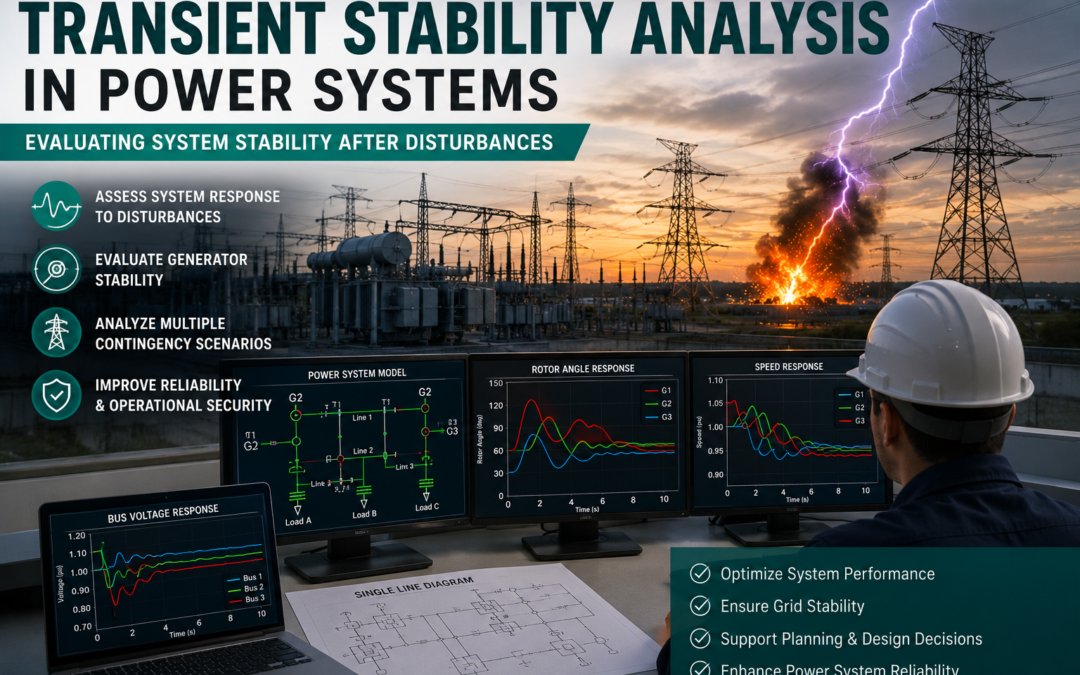
Transient Stability Analysis is an important Power System Study used to evaluate whether an electrical network can remain stable following major disturbances. In large industrial plants, utility networks, and substations, sudden faults, generator outages, or major load changes can significantly affect system operation.
Therefore, engineers perform Transient Stability Analysis to understand how generators, transformers, transmission lines, motors, and other electrical equipment respond to severe disturbances. The study helps determine whether the system can recover and continue operating in a stable condition.
Moreover, Transient Stability Analysis forms an important part of comprehensive Power System Studies, along with Load Flow Analysis, Electrical Network Analysis, Transformer Protection, and other electrical network studies.
Table of Contents
- What is Transient Stability Analysis?
- Why is Transient Stability Analysis Important?
- What Causes Transient Disturbances?
- How Transient Stability is Evaluated
- Critical System Parameters
- Engineering Methodology
- Simulation Scenarios
- Software Used for Transient Stability Studies
- Industrial Applications
- Benefits of Transient Stability Analysis
- Common Challenges
- Frequently Asked Questions
- Related Engineering Services
- Conclusion
What is Transient Stability Analysis?
Transient Stability Analysis evaluates the ability of a power system to maintain synchronism and recover following a major disturbance. Unlike normal operating studies, transient stability studies focus on the dynamic response of the electrical network immediately after a severe event.
For example, a three-phase fault, sudden generator outage, transmission line trip, or significant load change can cause rapid changes in electrical power and generator rotor angles. Engineers simulate these events to determine whether the system remains stable.
Furthermore, the study helps engineers understand the interaction between generators, transformers, transmission lines, loads, and protection systems during and after a disturbance.
Typical Disturbances Studied
- Three-phase faults
- Transmission line faults
- Generator outages
- Transformer outages
- Sudden load changes
- Transmission line tripping
- Generator disconnection
- Major switching events
Why is Transient Stability Analysis Important?
Modern electrical networks operate with interconnected generators, transformers, transmission systems, industrial loads, and renewable energy sources. Consequently, a disturbance in one part of the network can affect the stability of the entire system.
Transient Stability Analysis allows engineers to identify potential instability before commissioning or modifying an electrical network. As a result, appropriate protection schemes, equipment ratings, operating limits, and system configurations can be established.
Main Objectives
- Evaluate system stability following major disturbances.
- Verify generator synchronism.
- Identify unstable operating conditions.
- Evaluate generator rotor angle response.
- Assess the impact of faults and equipment outages.
- Determine critical system operating conditions.
- Support protection and system planning decisions.
- Improve overall electrical network reliability.
What Causes Transient Disturbances?
Transient disturbances can occur because of electrical faults, equipment failures, switching events, or sudden changes in generation and demand. These events can create significant changes in system voltage, current, electrical power, and generator rotor angle.
Common Causes
- Short-circuit faults.
- Generator tripping.
- Transformer failure or tripping.
- Transmission line outages.
- Large load rejection.
- Sudden load addition.
- Protection system operation.
- Major switching operations.
Therefore, studying these events before commissioning helps organizations understand potential system weaknesses and develop appropriate mitigation strategies.
How Transient Stability is Evaluated
Transient Stability Analysis generally begins with an accurate representation of the electrical network. Engineers develop the system model using the latest Single Line Diagram, equipment data, generation information, transformer parameters, transmission line characteristics, and load data.
The system is first evaluated under an appropriate pre-disturbance operating condition. Engineers then introduce a defined disturbance and simulate the network response over time.
Typical Analysis Process
- Review the latest Single Line Diagram.
- Collect generator and transformer data.
- Collect transmission line and cable parameters.
- Establish the pre-disturbance operating condition.
- Define credible disturbance scenarios.
- Simulate the disturbance.
- Evaluate generator and network response.
- Review system recovery following fault clearing.
- Identify unstable or critical operating conditions.
- Prepare engineering recommendations and final report.
Critical System Parameters
Several electrical and dynamic parameters are monitored during a Transient Stability Analysis. These parameters provide engineers with information about the response and recovery of the power system following a disturbance.
Generator Rotor Angle
Generator rotor angle is an important indicator of system synchronism. Engineers evaluate rotor angle behaviour following a disturbance to determine whether generators remain synchronized with the electrical network.
System Voltage
Voltage response is monitored during and after the disturbance. Significant or prolonged voltage instability may indicate that additional system evaluation or corrective measures are required.
Generator Speed
Generator speed response is evaluated to understand the dynamic behaviour of generating units following major disturbances.
Power Transfer
Power transfer between generators, transmission lines, and loads can change significantly during a disturbance. Therefore, engineers evaluate system power flows before, during, and after the event.
Engineering Methodology for Transient Stability Analysis
A reliable Transient Stability Study depends on accurate system modelling and realistic operating scenarios. Engineers combine network data, equipment characteristics, operating conditions, and disturbance events to evaluate the complete dynamic response of the electrical system.
Typical Engineering Workflow
- Review the electrical network configuration.
- Verify generation and load data.
- Review transformer and transmission system parameters.
- Develop the power system model.
- Establish normal operating conditions.
- Define fault and outage scenarios.
- Perform transient simulations.
- Evaluate generator synchronism and system response.
- Identify critical operating scenarios.
- Recommend appropriate engineering improvements.
- Prepare the final Transient Stability Analysis report.
Consequently, a systematic engineering approach helps identify potential stability problems before they become operational issues.
Simulation Scenarios
Engineers normally evaluate multiple disturbance scenarios because electrical networks can experience different combinations of faults, equipment outages, and operating conditions.
Typical Simulation Cases
- Three-phase fault followed by protection clearing.
- Transmission line trip.
- Generator trip.
- Transformer trip.
- Major load rejection.
- Large load addition.
- Fault at critical network locations.
- Different generation and loading conditions.
Furthermore, comparing different operating scenarios helps engineers identify the most critical system conditions and evaluate the overall stability margin of the network.
Software Used for Transient Stability Studies
Modern Transient Stability Analysis is performed using advanced electrical power system simulation software. These platforms allow engineers to model network behaviour and simulate different disturbance scenarios before implementing changes in the field.
Commonly Used Software
- ETAP
- DIgSILENT PowerFactory
- PSCAD
- PowerWorld Simulator
- PSS®E
These software platforms support detailed power system modelling, dynamic simulation, fault analysis, and engineering reporting. Therefore, they help engineers evaluate complex electrical networks more efficiently.
Industrial Applications of Transient Stability Analysis
Transient Stability Analysis is useful across a wide range of electrical infrastructure projects where system reliability and dynamic performance are important.
- Utility transmission networks
- Electrical substations
- Large industrial plants
- Oil and gas facilities
- Manufacturing industries
- Renewable energy projects
- Solar power plants
- Wind energy projects
- Battery Energy Storage Systems (BESS)
- Large commercial electrical networks
- Data centres
- Metro rail infrastructure
Similarly, the study can support network expansion, modernization, and major electrical system modifications where changes in generation, loading, or network configuration may affect system stability.
Benefits of Transient Stability Analysis
Transient Stability Analysis provides engineers with valuable information about the response of an electrical network during severe disturbances. Therefore, it can support safer system planning and improve long-term network reliability.
- Improves understanding of system dynamic behaviour.
- Identifies potential instability conditions.
- Supports generator synchronism assessment.
- Helps evaluate critical fault scenarios.
- Supports protection system planning.
- Improves network reliability.
- Supports system expansion planning.
- Reduces risk of widespread system instability.
- Improves confidence before commissioning.
- Supports reliable operation of interconnected power systems.
Common Challenges in Transient Stability Studies
The accuracy of a Transient Stability Study depends significantly on the quality of the system model and input data. Incomplete equipment information, outdated network documentation, or incorrect operating assumptions can affect simulation results.
Common Challenges
- Incomplete generator data.
- Outdated Single Line Diagrams.
- Incorrect network configuration.
- Incomplete protection information.
- Unverified operating conditions.
- Incorrect dynamic model parameters.
- Insufficient disturbance scenarios.
- Changes in network configuration after the study.
Therefore, engineers should use the latest available engineering documentation and validate important system data before performing the final study.
Frequently Asked Questions
1. What is Transient Stability Analysis?
Transient Stability Analysis evaluates the ability of a power system to remain stable following major disturbances such as faults, generator outages, sudden load changes, or transmission line trips.
2. Why is Transient Stability Analysis required?
The study helps engineers identify potential instability conditions and evaluate how generators and the electrical network respond after major disturbances.
3. What events are normally studied?
Typical events include three-phase faults, transmission line outages, generator trips, transformer trips, sudden load changes, and major switching events.
4. Which software is used for Transient Stability Analysis?
Commonly used power system simulation platforms include ETAP, DIgSILENT PowerFactory, PSCAD, PowerWorld Simulator, and PSS®E.
5. Can Transient Stability Analysis be used for industrial plants?
Yes. Large industrial facilities with significant generation, large motors, interconnected electrical networks, or critical loads can benefit from Transient Stability Analysis to evaluate system behaviour following major disturbances.
Related Engineering Services
- Power System Studies
- Load Flow Analysis
- Electrical Network Analysis
- Arc Flash Study
- Transformer Protection
- Electrical Engineering Services
- Electrical Engineering Consultancy
Conclusion
Transient Stability Analysis is an important component of comprehensive Power System Studies. By evaluating the response of generators, transformers, transmission systems, and loads following major disturbances, engineers can identify potential stability problems before commissioning or modifying an electrical network.
Furthermore, evaluating multiple operating conditions and credible disturbance scenarios provides a better understanding of system behaviour. Consequently, organizations can improve network reliability, support protection planning, reduce operational risks, and make informed engineering decisions.
Whether the project involves a utility network, industrial facility, electrical substation, renewable energy plant, or large commercial installation, professional Transient Stability Analysis can provide valuable insight into the dynamic performance of the electrical system.
Related Power System Studies
Explore our related engineering guides to understand other important Power System Studies:
- Load Flow Analysis in Electrical Systems – Complete Guide
- Arc Flash Study in Electrical Systems – Complete Guide
- Electrical Network Analysis in Power Systems – Complete Guide
- Transformer Protection in Power Systems – Complete Guide
Looking for professional engineering consultancy? Explore our Power System Studies & Electrical Engineering Services .
Need Expert Transient Stability Analysis Services?
Aums Praxis provides comprehensive Power System Studies, including Transient Stability Analysis, Load Flow Analysis, Short Circuit Studies, Protection Coordination, Arc Flash Studies, Harmonic Analysis, and Electrical Network Analysis for industrial, commercial, utility, and renewable energy projects.
Contact Our Engineering Experts