Arc Flash Study in Electrical Systems – Complete Guide
Electrical safety is one of the most critical aspects of designing, operating, and maintaining modern power systems. As electrical networks become larger and more complex, the risk of dangerous electrical faults also increases. Therefore, engineers perform an Arc Flash Study to evaluate potential hazards, protect personnel, and ensure compliance with internationally recognized electrical safety standards.
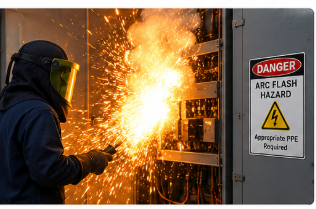
An electrical arc flash can release an enormous amount of thermal energy within a fraction of a second. Consequently, it may cause severe burns, equipment damage, production downtime, and even fatalities if proper protection measures are not implemented. By conducting a professional Arc Flash Study, organizations can identify hazardous locations, determine incident energy levels, and specify the appropriate personal protective equipment (PPE) for electrical workers.
Moreover, an Arc Flash Study is not an independent engineering assessment. It is usually performed together with Power System Studies, Load Flow Analysis, Short Circuit Study, and Relay Coordination Study to provide a complete evaluation of electrical system performance and safety.
Table of Contents
- What is an Arc Flash Study?
- Why is an Arc Flash Study Important?
- How Does an Arc Flash Occur?
- Causes of Arc Flash Incidents
- Standards Governing Arc Flash Studies
- Input Data Required
- Software Used
- Engineering Process
- Industrial Applications
- Benefits of Arc Flash Analysis
- Frequently Asked Questions
- Conclusion
What is an Arc Flash Study?
An Arc Flash Study is a detailed engineering analysis performed to calculate the incident energy released during an electrical arc fault. The study helps determine the level of risk associated with energized electrical equipment and recommends suitable protective measures for personnel working on or near electrical systems.
Unlike a Short Circuit Study, which calculates fault currents, an Arc Flash Study focuses on the thermal energy generated during an arc fault and its potential impact on people and equipment. Furthermore, the study evaluates protective device operating times, equipment configuration, and system parameters to estimate the severity of an arc flash event accurately.
The final engineering report typically includes incident energy calculations, arc flash boundaries, PPE recommendations, equipment labels, and practical safety measures that help organizations comply with electrical safety regulations while minimizing operational risks.
Why is an Arc Flash Study Important?
An Arc Flash Study plays a vital role in protecting electrical workers, improving workplace safety, and reducing the likelihood of catastrophic electrical accidents. Without proper analysis, maintenance personnel may unknowingly work in hazardous environments where the incident energy exceeds the protection offered by standard PPE.
Additionally, regulatory authorities and industry standards require organizations to assess electrical hazards and implement appropriate safety procedures. As a result, conducting an Arc Flash Study not only enhances worker safety but also supports legal compliance and operational reliability.
Major Objectives of an Arc Flash Study
- Calculate incident energy levels.
- Determine arc flash boundaries.
- Select appropriate PPE.
- Improve electrical worker safety.
- Reduce equipment damage.
- Support compliance with NFPA 70E and IEEE 1584.
- Minimize production downtime.
- Improve maintenance planning.
- Enhance overall electrical system safety.
How Does an Arc Flash Occur?
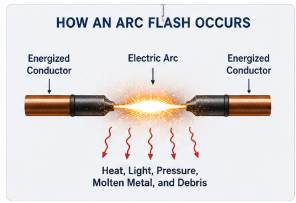
An Arc Flash occurs when an electric current leaves its intended path and travels through the air between energized conductors or between a conductor and the ground. As a result, an extremely high-temperature electric arc is created, releasing intense heat, bright light, pressure waves, molten metal, and flying debris within milliseconds.
During an arc flash event, temperatures can exceed 35,000°F (approximately 19,400°C), which is nearly four times hotter than the surface of the sun. Consequently, even personnel standing several meters away may suffer severe burns, hearing damage, eye injuries, or fatal injuries if adequate protection is not in place.
Moreover, the severity of an Arc Flash depends on several factors, including the available fault current, the duration of the fault, the operating time of protective devices, and the distance between the worker and the energized equipment. Therefore, performing a professional Arc Flash Study is essential for determining the actual level of risk.
Common Causes of Arc Flash Incidents
Although modern electrical systems are designed with multiple safety features, Arc Flash incidents can still occur due to equipment failure, human error, or inadequate maintenance. However, many of these incidents can be prevented through proper engineering studies, routine inspections, and compliance with electrical safety standards.
Major Causes of Arc Flash
- Equipment insulation failure.
- Loose electrical connections.
- Incorrect maintenance procedures.
- Human error during live electrical work.
- Dust, moisture, or contamination inside switchgear.
- Accidental contact with energized conductors.
- Damaged cables and busbars.
- Improper operation of circuit breakers.
- Failure of protective relays.
- Ageing electrical equipment.
- Improper installation practices.
- Mechanical damage to electrical panels.
Furthermore, industrial facilities operating at medium and high voltages face greater Arc Flash risks because higher fault currents can generate significantly greater incident energy. Consequently, industries should periodically review and update their Arc Flash Studies whenever modifications are made to the electrical system.
Consequences of Arc Flash Incidents
An Arc Flash incident can have serious consequences for personnel, equipment, and business operations. In addition to causing severe physical injuries, it may also result in substantial financial losses due to equipment replacement, production downtime, and regulatory penalties.
Possible Consequences
- Severe skin burns.
- Permanent eye injuries.
- Hearing loss caused by blast pressure.
- Damage to switchgear and transformers.
- Electrical fires.
- Extended production downtime.
- Unexpected equipment failures.
- Legal liabilities and insurance claims.
- Increased maintenance costs.
- Loss of business continuity.
Therefore, organizations should treat Arc Flash Studies as an essential component of their electrical safety program rather than merely a regulatory requirement.
What is Incident Energy?
Incident Energy is the amount of thermal energy released during an Arc Flash event that reaches a worker standing at a specific distance from the electrical equipment. It is typically measured in calories per square centimeter (cal/cm²) and forms the basis for selecting the appropriate level of Personal Protective Equipment (PPE).
For example, if the calculated incident energy exceeds the protection level of the worker's clothing, the risk of serious burns increases significantly. Therefore, accurate incident energy calculations are one of the most important outcomes of an Arc Flash Study.
Key Engineering Insight
Reducing the operating time of protective devices, improving relay coordination, and limiting available fault current can significantly reduce incident energy levels. Consequently, Arc Flash Studies are often performed together with Relay Coordination Studies and Short Circuit Studies to achieve the highest level of electrical safety.
Standards Governing Arc Flash Studies
An Arc Flash Study should always be performed in accordance with internationally recognized electrical safety standards. These standards provide detailed guidelines for hazard assessment, incident energy calculations, protective device coordination, equipment labeling, and the selection of appropriate Personal Protective Equipment (PPE). Consequently, organizations can create a safer working environment while ensuring compliance with legal and industry requirements.
Moreover, following recognized standards improves the consistency and accuracy of engineering studies. As a result, electrical engineers can make informed decisions regarding system modifications, maintenance planning, and worker safety.
Major Standards Used for Arc Flash Analysis
- IEEE 1584 – Guide for Performing Arc Flash Hazard Calculations.
- NFPA 70E – Standard for Electrical Safety in the Workplace.
- OSHA Regulations – Occupational electrical safety requirements.
- IEC Standards – International electrical installation and safety standards.
- National Electrical Code (NEC) – Safe electrical installation practices.
In practice, engineers generally use IEEE 1584 for incident energy calculations, while NFPA 70E provides guidance on PPE selection, safe work practices, and electrical safety procedures. Therefore, both standards are commonly referenced together during Arc Flash Studies.
Input Data Required for an Arc Flash Study
The accuracy of an Arc Flash Study depends largely on the quality of the available electrical system data. Therefore, engineers collect detailed information about the electrical network before beginning the analysis.
Furthermore, incomplete or outdated information may lead to inaccurate incident energy calculations, incorrect PPE recommendations, and unreliable Arc Flash labels. Consequently, field verification is often performed before finalizing the engineering study.
Typical Input Data Includes
- Single Line Diagram (SLD).
- Utility fault level information.
- Transformer ratings and impedance.
- Generator specifications.
- Circuit breaker settings.
- Protective relay settings.
- Cable lengths and sizes.
- Switchgear configuration.
- Motor ratings.
- Bus voltage levels.
- Equipment operating modes.
- Existing Arc Flash labels (if available).
Engineering Process for Performing an Arc Flash Study
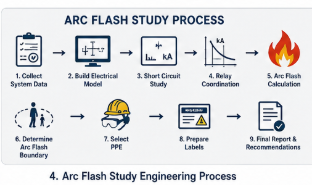
A professional Arc Flash Study follows a structured engineering methodology. Initially, engineers collect system information and create an accurate electrical model. Subsequently, specialized software is used to simulate fault conditions and calculate incident energy levels throughout the electrical network.
Typical Engineering Workflow
- Collect the latest Single Line Diagram (SLD).
- Verify field data and equipment ratings.
- Create the electrical model using engineering software.
- Perform a Short Circuit Study.
- Carry out Protective Relay Coordination.
- Calculate incident energy values.
- Determine Arc Flash boundaries.
- Select appropriate PPE categories.
- Generate Arc Flash warning labels.
- Prepare the final engineering report with recommendations.
Additionally, engineers often recommend modifications such as adjusting relay settings, replacing protective devices, or reducing fault clearing times to minimize incident energy. As a result, electrical workers can perform maintenance activities with a significantly lower level of risk.
Software Used for Arc Flash Studies
Modern Arc Flash Studies are performed using advanced electrical engineering software capable of accurately simulating fault conditions and calculating incident energy. Compared to manual calculations, these applications provide faster, more reliable, and standards-compliant results.
Commonly Used Software
- ETAP
- SKM Power Tools
- EasyPower
- DIgSILENT PowerFactory
- CYME
- PowerWorld Simulator
- MATLAB / Simulink (for research applications)
Among these platforms, ETAP, EasyPower, and SKM Power Tools are widely used by electrical consultants, EPC companies, industrial facilities, and utilities because they support both Arc Flash calculations and comprehensive Power System Studies.
Engineering Best Practice
For the most accurate results, an Arc Flash Study should never be performed in isolation. Instead, it should be integrated with Short Circuit Studies, Relay Coordination Studies, and Load Flow Analysis. This integrated approach improves both electrical safety and overall system reliability.
Industrial Applications of Arc Flash Studies
An Arc Flash Study is essential for any facility where personnel work on or near energized electrical equipment. Although every electrical installation is different, the objective remains the same—protect people, improve operational safety, and reduce the risk of severe electrical accidents. Therefore, Arc Flash Studies are widely performed across industrial, commercial, and utility sectors.
Furthermore, industries operating medium-voltage and high-voltage systems face greater risks because higher fault currents can generate significantly higher incident energy. Consequently, regular Arc Flash assessments become an important part of preventive maintenance and electrical safety programs.
Industries That Require Arc Flash Studies
- Manufacturing Plants
- Oil & Gas Facilities
- Power Generation Stations
- Electrical Substations up to 400 kV
- Steel and Cement Plants
- Data Centers
- Hospitals
- Commercial Buildings
- Water Treatment Plants
- Mining Operations
- Renewable Energy Projects
- Utility Transmission & Distribution Networks
Similarly, organizations planning plant expansion or equipment upgrades should update their Arc Flash Study whenever major modifications are made to the electrical system. This ensures that safety labels and incident energy calculations remain accurate.
Benefits of Performing an Arc Flash Study
A professionally executed Arc Flash Study offers both technical and operational benefits. Most importantly, it helps organizations identify electrical hazards before maintenance activities begin. As a result, workers can perform their duties more safely while reducing the likelihood of costly accidents.
Key Benefits
- Improves worker safety.
- Calculates incident energy accurately.
- Determines Arc Flash boundaries.
- Supports correct PPE selection.
- Reduces equipment damage.
- Minimizes production downtime.
- Improves compliance with safety standards.
- Supports insurance and audit requirements.
- Reduces maintenance risks.
- Enhances overall electrical system reliability.
- Improves emergency preparedness.
- Supports long-term asset management.
Moreover, organizations that regularly review their Arc Flash Studies often experience improved maintenance planning, better employee confidence, and reduced operational interruptions. Consequently, investing in electrical safety also delivers long-term financial benefits.
Understanding Arc Flash Warning Labels
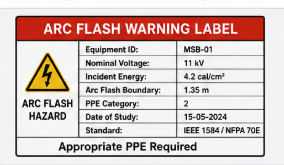
Once an Arc Flash Study has been completed, engineers prepare Arc Flash warning labels for electrical equipment. These labels provide critical information that helps maintenance personnel understand the hazards before opening or servicing energized equipment.
Typical Information on an Arc Flash Label
- Equipment identification.
- Nominal system voltage.
- Available fault current.
- Incident energy value (cal/cm²).
- Arc Flash boundary.
- Minimum PPE requirement.
- Date of study.
- Reference standard (IEEE 1584 / NFPA 70E).
Additionally, warning labels should always remain visible, legible, and updated whenever changes are made to the electrical distribution system. Otherwise, outdated labels may expose workers to unnecessary risks.
Personal Protective Equipment (PPE) for Arc Flash Safety
Selecting the correct Personal Protective Equipment (PPE) is one of the primary outcomes of an Arc Flash Study. PPE protects workers from thermal energy, flying debris, intense light, and pressure waves generated during an arc flash event. However, PPE should never replace safe work practices—it should be considered the last line of defense.
Common Arc Flash PPE Includes
- Arc-rated clothing.
- Arc-rated face shield.
- Safety helmet.
- Voltage-rated gloves.
- Leather protectors.
- Safety glasses.
- Hearing protection.
- Safety footwear.
- Insulated tools.
Furthermore, PPE selection depends on the calculated incident energy rather than equipment voltage alone. Therefore, two electrical panels operating at the same voltage may require completely different levels of protection.
Safety Tip
Never rely solely on equipment voltage to determine PPE requirements. Instead, always follow the incident energy calculations and Arc Flash labels generated during the engineering study. This approach significantly improves worker safety and supports compliance with NFPA 70E and IEEE recommendations.
Common Mistakes During Arc Flash Studies
Although many organizations recognize the importance of electrical safety, Arc Flash Studies are not always updated when electrical systems change. Consequently, outdated calculations and incorrect safety labels may expose personnel to unnecessary risks.
Furthermore, using incomplete system data or incorrect protective device settings can significantly affect incident energy calculations. Therefore, Arc Flash Studies should always be performed and reviewed by qualified electrical engineers using verified field data.
Common Mistakes to Avoid
- Using outdated Single Line Diagrams (SLDs).
- Ignoring recent equipment modifications.
- Failing to update protective relay settings.
- Not verifying field data before analysis.
- Using incorrect fault current values.
- Ignoring motor contribution during fault calculations.
- Failing to replace outdated Arc Flash labels.
- Assuming voltage alone determines PPE requirements.
- Not reviewing the study after system expansion.
- Performing safety assessments without Short Circuit or Relay Coordination Studies.
Ultimately, maintaining an up-to-date Arc Flash Study is just as important as conducting the initial analysis. Regular reviews help ensure that electrical safety measures remain effective throughout the lifecycle of the facility.
Frequently Asked Questions
What is an Arc Flash Study?
An Arc Flash Study is an engineering assessment that calculates the thermal energy released during an electrical arc fault. It helps determine incident energy levels, Arc Flash boundaries, and the appropriate PPE required to protect personnel working on energized electrical equipment.
Why is an Arc Flash Study important?
An Arc Flash Study improves workplace safety by identifying electrical hazards before maintenance or operational activities begin. Moreover, it supports compliance with standards such as IEEE 1584 and NFPA 70E while helping organizations reduce equipment damage and operational downtime.
Which industries require an Arc Flash Study?
Arc Flash Studies are commonly performed in manufacturing plants, oil and gas facilities, substations, power generation stations, renewable energy projects, commercial buildings, hospitals, data centers, mining operations, and utility transmission networks.
Which software is used for Arc Flash Analysis?
Engineers typically use ETAP, EasyPower, SKM Power Tools, DIgSILENT PowerFactory, and CYME to perform Arc Flash calculations in accordance with IEEE 1584 and other applicable standards.
When should an Arc Flash Study be updated?
An Arc Flash Study should be reviewed whenever major changes are made to the electrical distribution system, such as adding new transformers, modifying protective device settings, expanding production facilities, or replacing switchgear.
What information is included on an Arc Flash label?
A typical Arc Flash label includes the incident energy value, Arc Flash boundary, equipment identification, system voltage, required PPE level, and the reference standard used during the engineering study.
Related Engineering Services
Arc Flash Studies are most effective when combined with other electrical engineering assessments. Therefore, organizations should consider a complete Power System Study to improve both electrical safety and operational reliability.
- Power System Studies up to 400 kV
- Load Flow Analysis
- Short Circuit Study
- Relay Coordination Study
- Voltage Drop Calculation
- Cable Sizing
- Earthing System Design
Conclusion
An Arc Flash Study is an essential engineering assessment that helps organizations understand electrical hazards, calculate incident energy, and implement effective protective measures for personnel working on energized systems. Consequently, it plays a critical role in improving workplace safety, reducing equipment damage, and supporting regulatory compliance.
Furthermore, integrating Arc Flash Analysis with Short Circuit Studies, Relay Coordination Studies, and Load Flow Analysis provides a comprehensive understanding of electrical system performance. As a result, organizations can make informed engineering decisions while improving long-term reliability and operational efficiency.
Ultimately, investing in a professionally executed Arc Flash Study protects both people and critical electrical infrastructure. It also demonstrates a strong commitment to electrical safety, operational excellence, and compliance with internationally recognized engineering standards.
Related Power System Studies
Expand your knowledge of power system analysis by exploring our related engineering guides:
- Load Flow Analysis in Electrical Systems – Complete Guide
- Electrical Network Analysis in Power Systems – Complete Guide
- Transformer Protection in Power Systems – Complete Guide
Looking for professional engineering consultancy? Explore our Power System Studies & Electrical Engineering Services.
Need Professional Arc Flash Study Services?
Aums Praxis provides professional Arc Flash Studies, Power System Studies, Short Circuit Studies, Relay Coordination Studies, and complete electrical engineering consultancy for industrial plants, commercial facilities, utility networks, and renewable energy projects up to 400 kV.
Our experienced engineers deliver accurate hazard assessments, incident energy calculations, Arc Flash labeling, and practical safety recommendations in accordance with IEEE 1584 and NFPA 70E.
Contact our engineering team today to discuss your project requirements and receive a customized, reliable, and cost-effective electrical engineering solution.
Contact Us Now
Trackbacks/Pingbacks