
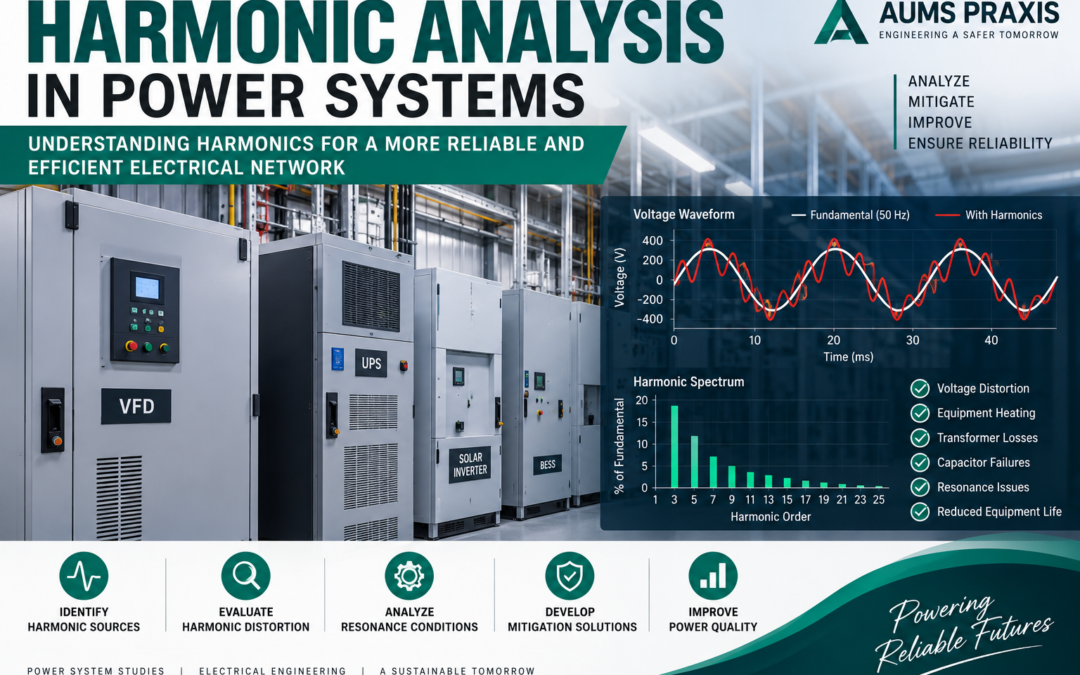
Harmonic Analysis helps engineers evaluate voltage distortion, current harmonics, resonance conditions, and their impact on electrical equipment. Modern industrial facilities increasingly use nonlinear loads such as Variable Frequency Drives (VFDs), UPS systems, converters, solar inverters, Battery Energy Storage Systems (BESS), and industrial automation equipment. Consequently, harmonic distortion has become an important consideration during electrical system design and operation.
Therefore, engineers perform Harmonic Analysis to understand harmonic sources, assess their impact on the electrical network, and develop suitable mitigation measures. As a result, organizations can improve power quality, protect critical equipment, reduce electrical losses, and enhance the long-term reliability of their power systems.
- What is Harmonic Analysis?
- Why is Harmonic Analysis Important?
- Common Sources of Harmonics
- Effects of Harmonic Distortion
- Harmonic Analysis Process
- Harmonic Resonance Analysis
- Harmonic Mitigation Methods
- Benefits of Harmonic Analysis
- Applications
- Standards and Compliance
- Common Challenges
- Frequently Asked Questions
- Related Engineering Services
- Conclusion
What is Harmonic Analysis?
Engineers use Harmonic Analysis to identify and evaluate harmonic currents and voltage distortion within an electrical network. Unlike purely linear loads, nonlinear equipment can draw current in a distorted waveform. Consequently, these currents can introduce harmonic components into the power system.
The analysis evaluates the magnitude and order of harmonics and determines how they affect transformers, cables, switchgear, capacitor banks, motors, generators, and other connected equipment. Furthermore, engineers can evaluate the overall power quality of the electrical network under different operating conditions.
For example, a facility containing a large number of VFDs, UPS systems, rectifiers, or power electronic converters may experience significant harmonic currents. Therefore, a detailed study can help engineers determine whether additional mitigation measures are required.
Why is Harmonic Analysis Important?
Power quality plays an important role in the safe and efficient operation of modern electrical systems. Harmonic distortion can increase electrical losses and create additional thermal stress in equipment. Moreover, excessive harmonic levels can affect sensitive electrical and electronic equipment.
Therefore, Harmonic Analysis helps engineers understand the behavior of the network before problems become operational issues. In addition, the study can identify potential harmonic sources and evaluate their effect on the complete electrical system.
- Evaluate voltage distortion
- Evaluate current harmonic levels
- Identify major harmonic sources
- Assess harmonic impact on electrical equipment
- Identify resonance conditions
- Evaluate transformer and cable heating
- Assess capacitor bank performance
- Improve overall power quality
- Support harmonic mitigation decisions
- Improve long-term electrical system reliability
Common Sources of Harmonics
Nonlinear electrical loads commonly produce harmonics. As industrial facilities become increasingly dependent on power electronic equipment, the number of potential harmonic sources also increases.
Variable Frequency Drives (VFDs)
VFDs are widely used for controlling motor speed and energy consumption. However, their power electronic converters can generate harmonic currents. Therefore, facilities with a large number of VFD-driven motors may require detailed harmonic evaluation.
UPS Systems
UPS systems provide reliable backup power for critical loads. Depending on their design and operating conditions, UPS systems can contribute harmonic currents to the electrical network. Consequently, engineers should consider their impact during power system studies.
Rectifiers and Converters
Industrial rectifiers and converters are another important source of harmonics. These systems are commonly found in manufacturing facilities, process industries, transportation systems, and other large electrical installations. Therefore, engineers should include significant converter loads in the harmonic model.
Solar Inverters
Renewable energy installations use power electronic inverters to connect solar generation to the electrical network. Therefore, engineers should evaluate the harmonic performance of the inverter and its interaction with the network during system design.
Battery Energy Storage Systems
BESS installations use power conversion systems to charge and discharge batteries. As a result, engineers should evaluate harmonic behavior when integrating battery storage with industrial or utility networks.
Industrial Automation Equipment
Modern automation systems contain various electronic power supplies and control equipment. Furthermore, large concentrations of electronic loads can contribute to overall harmonic distortion.
Effects of Harmonic Distortion
Excessive harmonic distortion can affect both electrical equipment and overall network performance. However, the severity of the impact depends on harmonic magnitude, harmonic order, system configuration, equipment characteristics, and operating conditions.
Transformer Heating
Harmonic currents can increase transformer losses and thermal stress. Therefore, engineers should carefully evaluate transformers that supply significant nonlinear loads.
Capacitor Bank Failures
Power factor correction capacitors can interact with system inductance and create resonance conditions. Consequently, harmonic currents may increase significantly and cause capacitor overheating or premature failure.
Cable Heating
Harmonic currents can increase losses in cables and conductors. As a result, excessive harmonic levels may contribute to additional heating and reduced equipment efficiency.
Equipment Malfunction
Sensitive electronic equipment can experience problems when power quality deteriorates. Therefore, harmonic evaluation is particularly important for facilities containing automation systems, data centres, control systems, and other sensitive loads.
Protection Relay Operations
High harmonic distortion can sometimes affect measurement and protection systems. In addition, unusual waveform conditions may contribute to unwanted protection operations if the system is not properly evaluated.
Reduced Equipment Life
Continuous thermal and electrical stress can reduce the service life of electrical equipment. Ultimately, controlling harmonic distortion can contribute to better equipment reliability and long-term asset performance.
Harmonic Analysis Process
A professional Harmonic Analysis normally follows a structured engineering workflow. However, the exact process depends on the size and complexity of the electrical network. Nevertheless, engineers commonly consider the following stages.
1. Collect Electrical System Data
Engineers collect information about transformers, generators, cables, switchgear, motors, capacitor banks, nonlinear loads, and operating conditions. In addition, engineers review equipment ratings and existing power quality information where available.
2. Develop the Electrical Network Model
Engineers use the collected information to develop a representative electrical network model. Consequently, the model can simulate harmonic behavior under different operating scenarios.
3. Identify Harmonic Sources
Engineers identify nonlinear loads that may generate harmonic currents. For example, these may include VFDs, UPS systems, rectifiers, converters, solar inverters, and BESS systems.
4. Perform Harmonic Load Flow
Engineers perform harmonic load flow calculations to determine harmonic current and voltage levels at different locations within the network. Furthermore, the calculations help engineers evaluate the contribution of individual harmonic sources.
5. Evaluate Voltage and Current Distortion
Engineers review the calculated results to determine harmonic distortion levels at important buses and equipment. Therefore, they can identify locations where harmonic performance requires attention.
6. Check Resonance Conditions
Engineers evaluate the interaction between network inductance, capacitance, and harmonic sources. As a result, they can identify potential parallel or series resonance conditions before such conditions create operational problems.
7. Develop Mitigation Solutions
If harmonic levels exceed acceptable limits, engineers evaluate suitable mitigation measures. These may include passive filters, active harmonic filters, detuned capacitor banks, or other network modifications. In addition, engineers consider the operating requirements and network characteristics before selecting a solution.
8. Verify the Final Design
Finally, engineers evaluate the proposed mitigation solution through additional simulations. This approach ensures that the selected solution improves harmonic performance without creating new resonance or operational issues.
Harmonic Resonance Analysis
Resonance is an important part of Harmonic Analysis because electrical networks contain inductive and capacitive elements. Under certain conditions, these elements can interact at specific frequencies and amplify harmonic currents or voltages.
For example, capacitor banks used for power factor correction can change the impedance characteristics of the network. Therefore, engineers should evaluate the interaction between capacitor banks and harmonic sources before finalizing the electrical design.
Furthermore, resonance analysis helps identify frequencies at which the network may become particularly sensitive to harmonic excitation. As a result, engineers can recommend suitable mitigation measures during the design stage.
Harmonic Mitigation Methods
When harmonic distortion exceeds acceptable levels, engineers can consider different mitigation methods. The most suitable solution depends on the harmonic source, network configuration, required performance, and project economics.
Passive Harmonic Filters
Passive filters use combinations of inductors, capacitors, and resistors to reduce specific harmonic components. Therefore, they can be effective for facilities with predictable harmonic sources.
Active Harmonic Filters
Active harmonic filters electronically compensate for unwanted harmonic currents. In addition, they can provide flexibility when harmonic levels vary with changing operating conditions.
Detuned Capacitor Banks
Detuned capacitor banks can reduce the risk of resonance between capacitor banks and system impedance. Consequently, they can be useful in installations where power factor correction and harmonic distortion need to be considered together.
Equipment Selection
Selecting equipment with suitable harmonic performance can reduce harmonic problems at the source. For example, low-harmonic drives and appropriately designed power conversion systems may improve overall network performance.
Network Design Optimization
Sometimes the best solution involves changes to the network configuration rather than installing a dedicated filter. Therefore, engineers may evaluate transformer configuration, cable arrangements, load distribution, and other system parameters.
Benefits of Harmonic Analysis
A detailed Harmonic Analysis provides valuable information for both new electrical installations and existing facilities. Moreover, early identification of harmonic problems can help organizations avoid costly equipment failures and operational interruptions.
- Improves power quality
- Reduces voltage distortion
- Reduces harmonic current levels
- Protects transformers and electrical equipment
- Reduces cable and equipment heating
- Helps prevent capacitor bank failures
- Identifies potential resonance conditions
- Improves equipment efficiency
- Supports reliable system operation
- Helps extend equipment service life
- Supports compliance with applicable standards
- Improves electrical system planning
Applications of Harmonic Analysis
Harmonic Analysis is useful across a wide range of industrial, commercial, utility, and renewable energy applications. Consequently, engineers can incorporate the study into both new project design and existing system assessments.
- Electrical substations
- Industrial manufacturing facilities
- Oil and gas facilities
- Data centres
- Solar PV plants
- Wind energy projects
- Battery Energy Storage Systems
- Commercial buildings
- Mining facilities
- Process industries
- Metro and railway infrastructure
- Large commercial and industrial power systems
Standards and Compliance
Engineers should evaluate harmonic performance against applicable project requirements, utility requirements, and recognized engineering standards. In particular, IEEE 519 is widely referenced for harmonic control and power quality assessment.
Therefore, engineers should review the applicable requirements for the specific project and electrical network. Furthermore, they should evaluate compliance at the appropriate point of common coupling and under representative operating conditions.
Harmonic limits and acceptance criteria can vary depending on the project, voltage level, network configuration, utility requirements, and applicable standards. Therefore, engineering assessment should always consider the actual project requirements rather than relying on assumptions.
Common Challenges in Harmonic Analysis
Although Harmonic Analysis provides valuable engineering information, accurate results depend on the quality of the electrical system model and input data. Therefore, engineers should pay particular attention to the following challenges.
- Incomplete electrical network data
- Incorrect equipment ratings
- Unknown harmonic source characteristics
- Changing industrial load conditions
- Incorrect capacitor bank modelling
- Inaccurate network impedance information
- Insufficient operating scenarios
- Changes to the electrical network after the original study
However, engineers can reduce these challenges through accurate data collection, appropriate modelling, multiple operating scenarios, and proper engineering review. As a result, the final study can provide more reliable information for system design and operation.
Frequently Asked Questions
1. What is Harmonic Analysis?
Harmonic Analysis is an electrical engineering study used to evaluate harmonic currents, voltage distortion, resonance conditions, and their impact on electrical equipment and network performance.
2. Why is Harmonic Analysis required?
Harmonic Analysis helps engineers identify harmonic sources and determine their impact on electrical equipment. Therefore, it can help improve power quality, reliability, and equipment performance.
3. What equipment produces harmonics?
Common harmonic-producing equipment includes VFDs, UPS systems, rectifiers, converters, solar inverters, BESS systems, and other nonlinear electronic loads.
4. What problems can harmonics cause?
Excessive harmonics can contribute to transformer heating, cable heating, capacitor failures, additional losses, equipment malfunction, resonance, and reduced equipment life.
5. Can Harmonic Analysis identify resonance?
Yes. Harmonic studies can evaluate the interaction between system impedance, inductive elements, capacitors, and harmonic sources. Consequently, engineers can identify potential resonance conditions.
6. How can harmonic distortion be reduced?
Depending on the system, mitigation may include passive filters, active harmonic filters, detuned capacitor banks, suitable equipment selection, and electrical network optimization.
7. Is Harmonic Analysis required for solar power systems?
Harmonic evaluation can be important for solar power systems because grid-connected inverters use power electronic conversion. Therefore, engineers should assess their interaction with the electrical network where applicable.
8. What standard is commonly used for harmonic limits?
IEEE 519 is widely referenced for harmonic control and power quality assessment. However, project-specific utility requirements and other applicable standards should also be considered.
Related Engineering Services
Harmonic Analysis is often performed as part of a broader Power System Study. Therefore, combining multiple engineering studies can provide a more complete understanding of electrical network performance.
- Power System Studies
- Load Flow Analysis in Electrical Systems
- Short Circuit Study
- Electrical Network Analysis
- Arc Flash Study
- Transformer Protection
- Electrical Engineering Consultancy
Conclusion
Harmonic Analysis plays an important role in evaluating power quality and electrical network performance in modern power systems. Nonlinear loads such as VFDs, UPS systems, converters, solar inverters, BESS systems, and industrial automation equipment can introduce harmonic currents into the network.
Therefore, a detailed harmonic study helps engineers identify harmonic sources, evaluate voltage and current distortion, assess resonance conditions, and determine suitable mitigation measures. Furthermore, integrating Harmonic Analysis with other Power System Studies can provide a more complete understanding of electrical system performance.
Ultimately, proper harmonic assessment helps organizations improve power quality, protect critical electrical equipment, reduce operational risks, and achieve reliable long-term electrical system performance.
Need Expert Harmonic Analysis Services?
Aums Praxis provides professional Harmonic Analysis, Power System Studies, Electrical Network Analysis, Load Flow Analysis, Short Circuit Studies, Arc Flash Studies, Transformer Protection, and electrical engineering consultancy services for industrial, commercial, utility, and renewable energy projects.
Contact Our Engineering Experts
Trackbacks/Pingbacks