
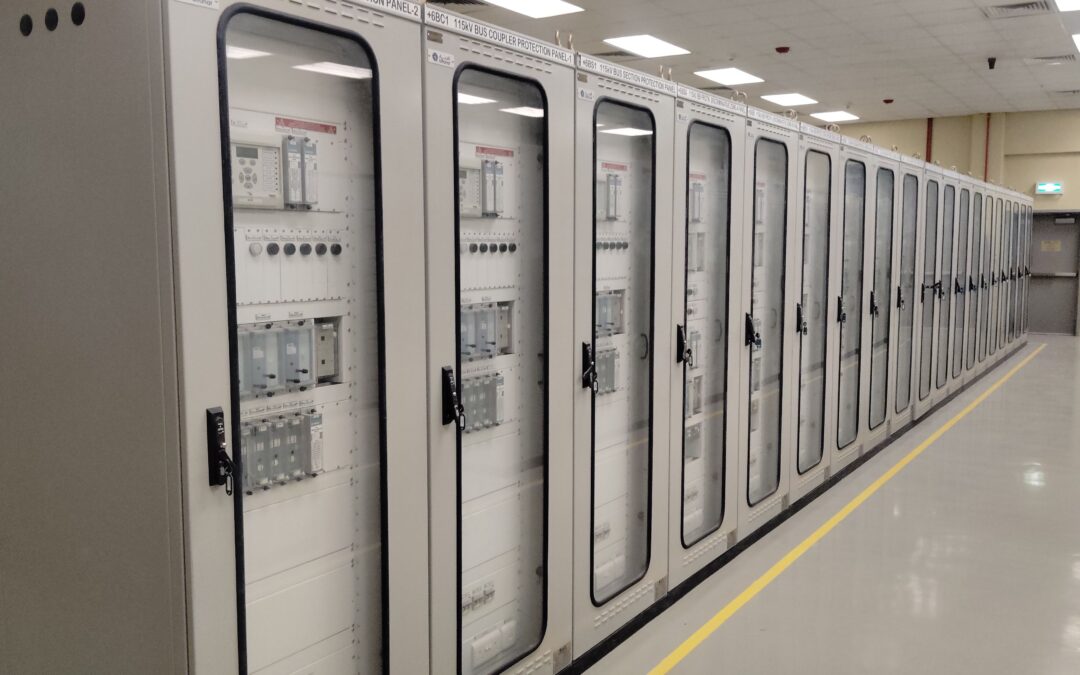
Modern electrical substations up to 400 kV are becoming increasingly complex due to higher power demand, renewable energy integration, and expanding transmission infrastructure. Therefore, every substation must undergo comprehensive Power System Studies before commissioning to ensure safe, reliable, and efficient operation.
Furthermore, commissioning a substation without proper electrical analysis may result in overloaded equipment, incorrect protection settings, excessive fault currents, voltage instability, and serious safety hazards. Consequently, professional engineering studies help identify potential issues before the substation is energized.
Power System Studies include Load Flow Analysis, Short Circuit Study, Arc Flash Study, Protection Coordination, Voltage Drop Analysis, Harmonic Analysis, and complete Electrical Network Analysis. Together, these studies verify that every component of the electrical system operates safely under both normal and fault conditions.
What Are Power System Studies?
Power System Studies are detailed engineering analyses performed to evaluate the performance, stability, safety, and reliability of an electrical network before it is commissioned. Additionally, these studies verify that transformers, switchgear, cables, protection relays, and other electrical equipment are correctly selected and properly coordinated.
Moreover, engineers use specialized power system software to simulate different operating conditions and fault scenarios. As a result, they can identify technical issues before they become operational problems.
These engineering studies are essential for industrial facilities, renewable energy plants, utility substations, commercial buildings, and transmission systems operating up to 400 kV.
Why Are Power System Studies Essential Before Commissioning a 400 kV Substation?
Commissioning marks the final stage before a substation becomes operational. However, energizing equipment without performing detailed electrical studies introduces significant technical and financial risks.
Therefore, utilities, EPC contractors, consultants, and industrial organizations perform comprehensive Power System Studies to verify that every electrical component functions as intended.
- Verify equipment ratings
- Ensure network stability
- Prevent transformer overloading
- Confirm cable sizing
- Validate protection relay settings
- Reduce commissioning risks
- Improve personnel safety
- Meet IEC and IEEE standards
- Reduce future maintenance costs
- Increase long-term reliability
Furthermore, identifying engineering issues during the design stage is significantly more cost-effective than correcting them after commissioning.
Load Flow Analysis
Load Flow Analysis is one of the most important Power System Studies performed before energizing a substation. It evaluates how electrical power flows throughout the network during normal operating conditions.
Additionally, engineers calculate voltage levels, active power, reactive power, transformer loading, feeder loading, and system losses. Consequently, they can verify that the electrical network will operate within acceptable limits.
Load Flow Analysis Helps To:
- Determine bus voltages
- Identify overloaded transformers
- Evaluate feeder loading
- Optimize reactive power flow
- Reduce transmission losses
- Improve voltage regulation
- Support future expansion planning
Likewise, utilities use Load Flow Analysis to assess different operating scenarios, including peak demand, minimum load conditions, and future network expansion.
Benefits of Performing Load Flow Analysis
Load Flow Analysis provides valuable insights into overall system performance. Therefore, engineers can optimize equipment selection while minimizing operational risks.
- Improved system efficiency
- Reduced energy losses
- Better voltage stability
- Optimized transformer utilization
- Improved network planning
- Lower operational costs
- Reliable power delivery
Short Circuit Study
A Short Circuit Study is another critical component of Power System Studies before commissioning a substation up to 400 kV. It determines the maximum fault current that can occur at different locations within the electrical network.
Furthermore, electrical faults such as three-phase faults, line-to-ground faults, double line faults, and phase-to-phase faults can produce extremely high current levels. Therefore, every switchgear component must be capable of safely interrupting these fault currents.
Consequently, engineers perform detailed fault calculations to verify that circuit breakers, transformers, busbars, cables, current transformers, and protection relays have sufficient interrupting capacity.
Short Circuit Studies Help Engineers To:
- Calculate maximum fault current levels
- Select suitable circuit breakers
- Verify switchgear interrupting ratings
- Validate transformer withstand capability
- Check busbar thermal limits
- Confirm cable short-circuit ratings
- Improve protection system performance
- Reduce equipment failure risks
Ultimately, Short Circuit Studies ensure that every electrical component remains protected during abnormal operating conditions.
Arc Flash Study
Electrical safety is one of the highest priorities during substation commissioning. Therefore, an Arc Flash Study is performed to determine the potential incident energy that personnel may be exposed to while operating electrical equipment.
Additionally, an arc flash event can generate extremely high temperatures, pressure waves, molten metal, and intense light within milliseconds. As a result, proper engineering analysis is essential for protecting maintenance personnel.
Arc Flash Studies calculate incident energy levels, flash protection boundaries, PPE requirements, and equipment labeling according to internationally recognized standards.
Benefits of Arc Flash Studies
- Protect maintenance personnel
- Reduce workplace accidents
- Improve electrical safety compliance
- Support PPE selection
- Reduce equipment damage
- Meet NFPA 70E recommendations
- Improve operational safety
Protection Coordination Study
Protection Coordination Studies ensure that protective devices operate in the correct sequence whenever a fault occurs. Consequently, only the faulty section of the electrical network is isolated while the remaining system continues operating normally.
Moreover, engineers coordinate protection relays, circuit breakers, reclosers, fuses, and other protective devices to achieve selective fault isolation.
- Relay coordination
- Time-current curve analysis
- Breaker coordination
- Fuse coordination
- Selective protection
- Improved system reliability
- Reduced outage duration
Likewise, proper protection coordination significantly improves system availability while minimizing unnecessary interruptions.
Voltage Drop Analysis
Voltage Drop Analysis evaluates voltage levels throughout the electrical network under various loading conditions. Furthermore, excessive voltage drop may reduce equipment performance and affect system efficiency.
Therefore, engineers calculate voltage profiles across feeders, transformers, and cable systems before commissioning.
- Verify acceptable voltage levels
- Optimize cable sizing
- Improve equipment performance
- Reduce power losses
- Support network expansion
- Improve power quality
As a result, Voltage Drop Analysis helps ensure stable and reliable power delivery throughout the substation.
Electrical Network Analysis
Electrical Network Analysis combines multiple engineering studies to evaluate the complete performance of an electrical system. Instead of examining individual components separately, engineers assess the interaction between transformers, generators, switchgear, cables, loads, and protection systems.
Furthermore, this integrated approach allows engineers to identify system weaknesses, optimize equipment selection, and improve operational reliability before commissioning.
- Load Flow Analysis
- Short Circuit Study
- Arc Flash Study
- Protection Coordination
- Voltage Drop Analysis
- Harmonic Analysis
- Motor Starting Analysis
- Transient Stability Studies
Consequently, Electrical Network Analysis provides complete confidence that the substation will operate safely, efficiently, and reliably throughout its service life.
Harmonic Analysis
Modern substations up to 400 kV increasingly supply nonlinear electrical loads, including variable frequency drives (VFDs), UPS systems, converters, solar inverters, battery energy storage systems (BESS), and industrial automation equipment. Consequently, harmonic distortion has become an important consideration during substation design.
Therefore, Harmonic Analysis is performed to evaluate voltage distortion, current harmonics, and their impact on electrical equipment. Furthermore, engineers ensure that harmonic levels remain within acceptable limits specified by international standards.
As a result, the electrical network operates more efficiently while minimizing equipment overheating, capacitor failures, transformer losses, and unwanted protection relay operations.
Harmonic Analysis Helps To:
- Reduce voltage distortion
- Improve power quality
- Protect transformers
- Prevent capacitor bank failures
- Reduce cable heating
- Improve equipment efficiency
- Increase equipment life
- Comply with IEEE 519 recommendations
Motor Starting Analysis
Large motors can draw several times their rated current during startup. Therefore, Motor Starting Analysis evaluates the effect of motor acceleration on the entire electrical network before commissioning.
Additionally, engineers calculate voltage dips, starting currents, acceleration time, and transformer loading under different operating conditions. Consequently, motor performance can be optimized without affecting other connected equipment.
- Evaluate voltage dip
- Verify transformer capacity
- Reduce starting disturbances
- Improve motor reliability
- Support equipment selection
- Protect sensitive loads
Transient Stability Analysis
Power systems must remain stable after major disturbances such as faults, sudden load changes, or generator outages. Therefore, Transient Stability Analysis evaluates how quickly the electrical system recovers following these events.
Furthermore, engineers simulate various operating scenarios to ensure that generators, transformers, transmission lines, and protection systems remain synchronized after disturbances.
Ultimately, transient stability studies improve overall system resilience while reducing the possibility of widespread power outages.
Transformer Loading Assessment
Transformers represent one of the most valuable assets within a substation. Consequently, their loading conditions must be carefully evaluated before commissioning.
Additionally, engineers verify transformer capacity under normal operation, emergency loading, and future expansion scenarios. As a result, transformer overloading can be avoided while maximizing asset utilization.
- Continuous loading assessment
- Emergency loading verification
- Thermal performance evaluation
- Future demand forecasting
- Transformer life optimization
Cable Sizing Validation
Although cable sizing is completed during the design phase, it must also be verified through Power System Studies before commissioning. Therefore, engineers validate conductor sizes using load flow results, voltage drop calculations, thermal limits, and short-circuit withstand capability.
Likewise, correctly sized cables improve efficiency, reduce energy losses, and increase long-term system reliability.
- Current carrying capacity
- Voltage drop verification
- Short-circuit withstand capability
- Thermal performance
- Installation conditions
- Future expansion capability
Compliance with IEC & IEEE Standards
Professional Power System Studies should always comply with internationally recognized engineering standards. Moreover, compliance improves safety, simplifies regulatory approvals, and increases confidence in system performance.
- IEC 60909 – Short Circuit Calculations
- IEC 60076 – Power Transformers
- IEC 60364 – Electrical Installations
- IEC 60255 – Protection Relays
- IEEE 399 – Industrial Power Systems
- IEEE 551 – Power System Analysis
- IEEE 1584 – Arc Flash Analysis
- IEEE 519 – Harmonic Control
Consequently, organizations can commission their substations with confidence, knowing that the entire electrical network has been verified against internationally accepted engineering practices.
Applications of Power System Studies
Power System Studies are essential for a wide variety of electrical infrastructure projects. For example, utilities, EPC contractors, renewable energy developers, industrial facilities, and commercial organizations rely on these studies before energizing new electrical installations.
- 400 kV Transmission Substations
- 220 kV Grid Stations
- 132 kV Distribution Substations
- Industrial Manufacturing Plants
- Oil & Gas Facilities
- Solar Power Plants
- Wind Energy Projects
- Battery Energy Storage Systems (BESS)
- Commercial Buildings
- Data Centers
- Metro Rail Infrastructure
- Airport Electrical Networks
Similarly, Power System Studies are equally valuable for expansion projects, modernization programs, and electrical network upgrades where system reliability and safety remain top priorities.
Benefits of Power System Studies Before Commissioning
Comprehensive Power System Studies provide utilities, industrial facilities, EPC contractors, and infrastructure developers with the confidence that every component of the electrical network will operate safely after commissioning. Furthermore, these studies reduce project risks while improving long-term system performance.
Additionally, identifying design issues before energization is considerably less expensive than correcting failures after the substation becomes operational. Therefore, professional engineering studies deliver both technical and financial benefits throughout the project lifecycle.
- Improved electrical safety
- Higher system reliability
- Optimized equipment selection
- Reduced commissioning risks
- Improved power quality
- Enhanced protection coordination
- Lower maintenance costs
- Longer equipment life
- Compliance with IEC & IEEE Standards
- Reduced operational downtime
- Future-ready electrical infrastructure
- Improved investment protection
Industries That Require Power System Studies
Power System Studies are required across multiple industries where reliable electrical infrastructure is essential. Consequently, organizations rely on these studies before energizing new substations or upgrading existing electrical systems.
- Utility Transmission Networks
- Electrical Substations up to 400 kV
- Renewable Energy Projects
- Solar PV Plants
- Wind Farms
- Battery Energy Storage Systems (BESS)
- Oil & Gas Facilities
- Manufacturing Industries
- Mining Projects
- Commercial Developments
- Metro Rail Infrastructure
- Airport Electrical Systems
- Data Centres
Related Engineering Services
Power System Studies are typically performed alongside several other engineering services. Therefore, combining these services provides a complete electrical engineering solution for utility, industrial, and infrastructure projects.
- Cable Design Services up to 400 kV
- Electrical & Substation Plant Design Services
- ICP Contestable Design Services
- IEEE Engineering Standards
Frequently Asked Questions
Why are Power System Studies required before commissioning?
Power System Studies verify that the electrical network can operate safely, reliably, and efficiently before it is energized. As a result, potential technical problems are identified during the design stage rather than after commissioning.
What software is commonly used for Power System Studies?
Engineers typically use ETAP, DIgSILENT PowerFactory, SKM PowerTools, CYME, and PSCAD to perform Load Flow Analysis, Short Circuit Studies, Arc Flash Analysis, Protection Coordination, and Electrical Network Analysis.
Which Power System Study is the most important?
Each study serves a different purpose. However, Load Flow Analysis, Short Circuit Study, Protection Coordination Study, and Arc Flash Study are generally considered essential before commissioning any substation up to 400 kV.
Are Power System Studies mandatory?
Although local regulations vary, most utilities, consultants, EPC contractors, and industrial organizations require comprehensive Power System Studies to ensure compliance with international engineering standards and utility specifications.
Can Power System Studies improve equipment life?
Yes. Furthermore, optimized electrical designs reduce overloading, improve protection performance, minimize electrical stress, and extend the service life of transformers, switchgear, cables, and other critical assets.
Conclusion
Power System Studies up to 400 kV are an essential part of every successful substation commissioning project. Moreover, these engineering studies verify the safety, reliability, efficiency, and operational performance of the complete electrical network before it is energized.
Additionally, Load Flow Analysis, Short Circuit Study, Arc Flash Study, Protection Coordination, Harmonic Analysis, and Electrical Network Analysis work together to identify potential issues at an early stage. Consequently, organizations can avoid costly failures, reduce commissioning risks, and improve long-term asset performance.
Ultimately, investing in professional Power System Studies provides confidence that every component of the substation will operate safely, efficiently, and in accordance with international engineering standards for many years to come.
Need Professional Power System Studies up to 400 kV?
Aums Praxis provides comprehensive Power System Studies, including Load Flow Analysis, Short Circuit Study, Arc Flash Study, Protection Coordination, and complete Electrical Network Analysis for substations, utility networks, industrial plants, and renewable energy projects.
Contact our experienced engineering team today to discuss your project requirements and receive a customized engineering solution.
Contact Us Now